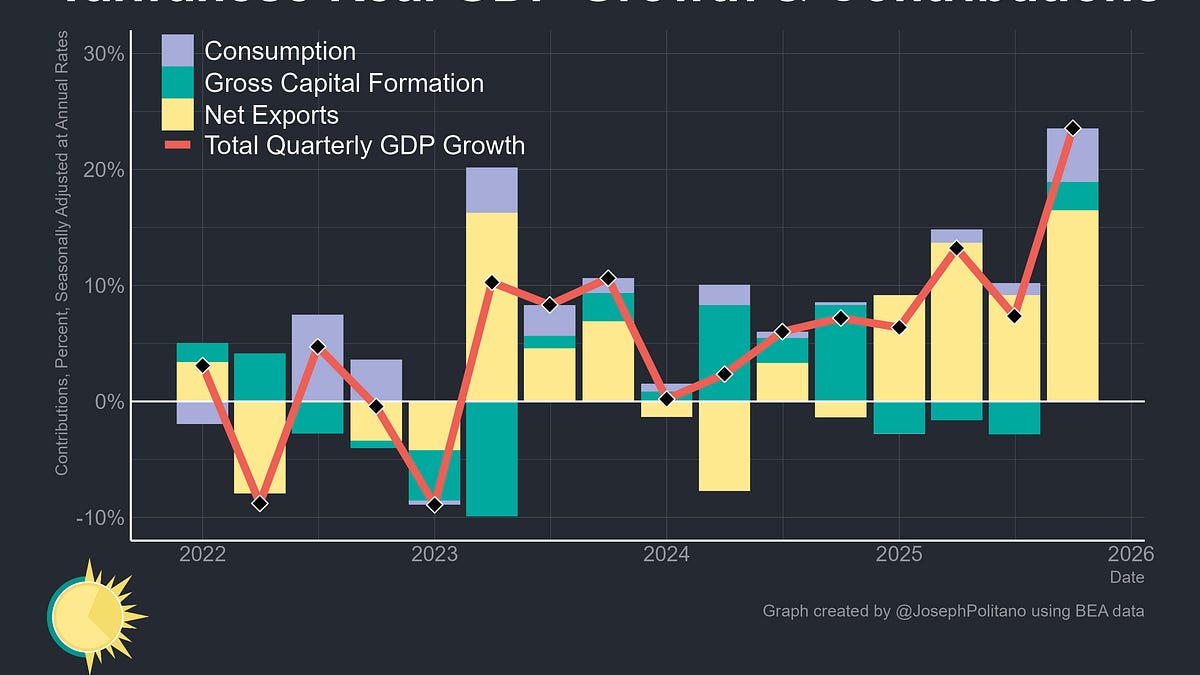
Taiwan’s economy has experienced remarkable growth, with a staggering 23.6% annualized rate in the last quarter of 2025, the fastest since the post-2008 recession recovery. This surge is largely attributed to the soaring demand for **AI chips** from **Taiwan Semiconductor Manufacturing Company (TSMC)**, significantly buoying the national economy. The boom in net exports, driven by a global race for computing power, has largely fueled this expansion, with data center builders in the **U.S.**, **China**, and elsewhere scrambling to secure high-performance chips.
Overall, the Taiwanese economy has grown more than 12% in the past year, reaching its fastest annual growth rate in nearly half a century. Since the launch of **ChatGPT** in late 2022, GDP has increased almost 23%. Both industrial production and export orders have hit record highs, with gross exports exceeding $63 billion per month, more than double pre-COVID levels. Manufacturing now constitutes nearly 40% of the economy, the highest share since the late 1980s. The global rush for artificial intelligence has catalyzed Taiwan’s return to growth rates reminiscent of its post-WWII economic miracle.
However, Taiwan finds itself in a precarious position as the world’s largest producer of cutting-edge chips and the primary manufacturer for AI chip designer **NVIDIA**. On one side stands **China**, Taiwan’s principal geopolitical adversary and the world’s second-largest consumer of computing power. China has repeatedly challenged traditional AI leaders with innovative models like **Qwen** and **Deepseek**. On the other side is the **United States**, which relies heavily on Taiwan for chips while simultaneously attempting to curtail China’s AI aspirations. The paradox is that both nations are eager to reduce their reliance on Taiwan, yet both remain dependent on its semiconductor manufacturing capabilities.
Taiwan has developed a “silicon shield” of high-end chip production to mitigate these geopolitical threats. As long as the **People’s Republic of China (PRC)** depends on Taiwanese semiconductors, an attack on the island becomes less likely. Conversely, as long as the U.S. relies on these chips, it is more likely to come to Taiwan’s aid. Both the U.S. and China are actively pursuing strategies to relocate semiconductor manufacturing away from the island to lessen their security dependencies. China has been indigenizing semiconductor production through national policies, while the U.S. has invested heavily in domestic semiconductor fabrication facilities under the **2022 CHIPS Act** and is using tariff threats to encourage **TSMC** to increase U.S.-based production.
Despite these efforts, the pressing need for AI chips that only Taiwan can provide complicates the situation. The U.S. government has restricted the export of NVIDIA’s flagship **B300** chip and the slightly modified **B30A** model, designed to comply with export control regulations. Instead, exports of the less powerful NVIDIA **H200** chips to China have been authorized, contingent upon a 25% revenue kickback to the U.S. government. Initially, China had banned these imports, negotiating for better alternatives while pushing for the development of its domestic semiconductor industry. However, it has recently allowed companies like **ByteDance**, **Alibaba**, and **Tencent** to import these chips for training their own AI models.
Looking ahead, Taiwan’s economic ascent appears poised to continue, with national forecasts predicting GDP growth nearing 8% in 2026, marking the third-highest rate this millennium. Export orders, a reliable indicator of future trade activity, have reached record levels, exceeding $76 billion and up 44% year-over-year. The U.S. has become Taiwan’s largest foreign customer, surpassing China in computer parts exports in 2022, and it continues to extend its lead, accounting for over $20 billion in Taiwanese computer and electronics exports monthly—more than twice that of any other major region.
In a significant shift, the U.S. now imports more directly from Taiwan than from China for the first time since 1992. While the U.S. still indirectly imports many Chinese goods, often transshipped through third countries, Taiwanese chips are now frequently integrated into more complex electronics produced elsewhere before reaching the U.S. This transformation represents a significant change in America’s overseas supply chain dependencies.
Nevertheless, Taiwan’s economic miracle comes with notable risks. The success of TSMC has created a two-tiered economy, where chip workers thrive while other sectors struggle. To mitigate potential economic pressures from an export boom, the country has taken steps to prevent currency appreciation, including deregulating life insurance companies that hold foreign-currency assets. A devalued currency could hinder consumers’ ability to afford vital imports, particularly food and energy, which are largely sourced from abroad. Taiwan is increasingly reliant on imported **LNG** to satisfy the energy demands of its semiconductor manufacturing. Additionally, any downturn in the fortunes of AI companies could have severe repercussions for Taiwan. The country will need to maintain its leadership in AI chip manufacturing while navigating a tense geopolitical landscape and managing its economic conditions to sustain its growth trajectory.
See also Quantum AI: Tackling Hype and Fraud Risks as Investment Surges in 2026
 Nvidia Halts H200 AI Chip Production for China Amid U.S. Export Caps
 Trump Administration Proposes AI Chip Export Controls for Nvidia and AMD Amid Rising Demand
 AWS Reveals Telecoms Plan to Outsource AI Infrastructure Amid Budget Constraints
 NUS Computing Partners with OpenAI to Enhance AI Curriculum for Future Graduates