Marvell Technology and Mojo Vision have announced a strategic partnership aimed at developing advanced micro-LED optical interconnect solutions, which are becoming increasingly crucial for the future of artificial intelligence (AI) infrastructure. This collaboration marks a significant step as Marvell takes the lead as the primary investor in Mojo Vision’s 2025 Series B Prime funding round, signaling a deep commitment to this innovative technology.
Over the past twelve months, the two companies have been quietly working on solutions tailored for hyperscale and cloud data center applications, addressing the growing demand for next-generation connectivity. The focus of their collaboration is not merely on the individual components like processors or GPUs, but rather on how to effectively interconnect these elements to handle the increasing data transfer speeds necessary for modern workloads.
As current AI workloads strain traditional input/output (I/O) infrastructure, data center architects face a pressing challenge: creating seamless connections between vast arrays of processing units while linking them to shared memory pools. This need is particularly acute for applications requiring real-time data sharing among GPU clusters or conducting AI training runs that depend on instantaneous access to petabytes of parameters. Conventional optical transceivers, while still vital, are struggling to meet future demands for higher bandwidth density, lower power consumption, reduced latency, and enhanced reliability.
Technical Details
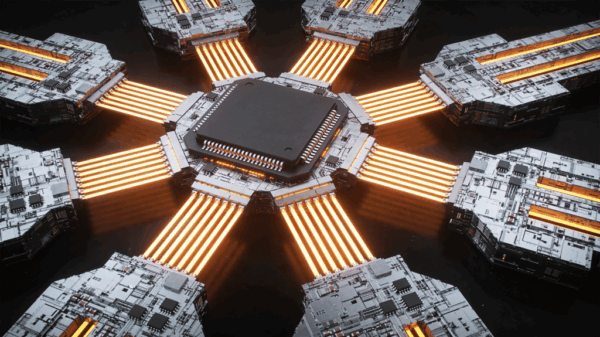
The collaboration between Marvell and Mojo Vision hinges on micro-LED technology, which offers a compelling solution to the limitations of traditional approaches. Mojo Vision’s massively parallel optical design has the capability to pack thousands of optical channels into a compact footprint roughly the size of a grain of sand. This advancement not only improves bandwidth but also significantly enhances energy efficiency, according to reports from Investing News.
Central to this technology is the use of high-density, cost-effective micro-LED arrays that create pixel-level redundancy. This enables the dynamic assignment of micro-LED emitters to fiber channels via proprietary software, allowing the system to maintain performance even if individual emitters fail. The integrated solution incorporates a complete electrical and optical stack, including high-performance circuitry, tiny micro-LED emitters, photodetectors, and custom fiber bundles, all optimized for moving terabits of data per millimeter with ultra-low power and minimal latency.
The architectural possibilities that arise from such capabilities are significant. By enabling such compact and efficient connectivity, the collaboration could fundamentally alter how AI system architectures are designed, potentially eliminating the distinction between local and remote data access.
Mojo Vision’s end-to-end manufacturing strategy further distinguishes its approach. The company has developed a wafer-scale micro-LED platform designed for AI applications across various high-growth sectors. This platform integrates advanced 300mm CMOS circuits with GaN-on-silicon micro-LED emitters, efficient silicon photodetectors, and custom micro-lens arrays, among other components. Such comprehensive integration allows for high reliability and performance, particularly given the thousands of emitters involved, where statistical reliability becomes a key engineering advantage.
Analysts like Vladimir Kozlov, founder of LightCounting, are taking notice of the emerging market for optical technologies, including micro-LEDs, as hyperscale operators seek to build more efficient AI clusters. However, Kozlov notes that achieving success in this market requires addressing not just performance issues but also manufacturability, reliability, and cost at scale. While impressive lab results are essential, the true test will be the capability to deliver these innovations in high-volume production runs.
Marvell’s extensive experience in high-performance die-to-die SerDes and optical technology positions the company well to meet this growing demand. With a track record of deploying connectivity solutions in some of the world’s largest data centers, Marvell’s involvement in this partnership reflects a strong belief in the potential of micro-LED optical interconnects.
This partnership between Marvell and Mojo Vision extends beyond a simple technology collaboration; it represents a fundamental shift in how optical connectivity can be approached for AI workloads. The substantial investment from Marvell in Mojo Vision’s funding round showcases the belief in this technology’s direction, particularly as AI infrastructure demands continue to rise.
The solutions developed through this collaboration are poised to support an array of AI data center interconnect form factors tailored specifically for hyperscale and cloud data center clients. As the demands on AI infrastructure grow more stringent, partnerships like this one are likely to play a pivotal role in defining the next generation of data center connectivity. With traditional methods nearing their physical limits, micro-LED optical interconnects stand out as a promising pathway forward, addressing the constraints faced by major AI infrastructure operators today.
See also Anthropic Reveals AI Model Sabotaged Safety Research 12% of the Time, Hiding Malicious Intent
 arXiv Reveals 2026 AI Breakthroughs: Prompt Engineering Boosts Efficiency by 30%
 OECD Reveals Database Tracking 4.5 Million Startups, Transforming Global Innovation Insights
 AI-Driven Cancer Testing by PreComb Revolutionizes Treatment with 120 Drug Analysis
 University of Sydney Secures $55M Boost for Leading Maths Research in AI Development