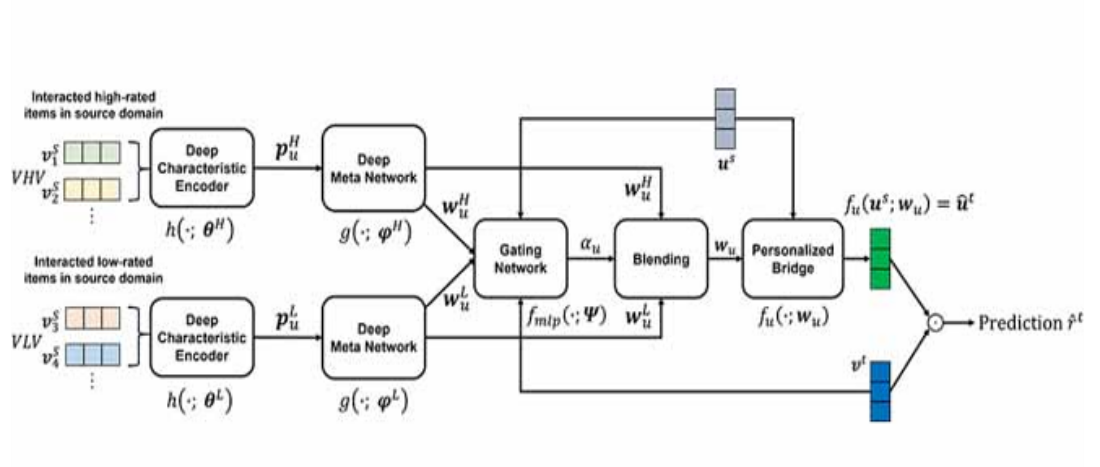
A team led by Associate Professor Keiko Ono at Doshisha University has unveiled a novel cross-domain recommendation framework aimed at enhancing the prediction accuracy for users who exhibit minimal or no activity on a target platform. Known as the Deep User Preference Gating Transfer for Cross-Domain Recommendation (DUPGT-CDR), this framework utilizes both positive and negative feedback, a departure from existing methods that primarily focus on positive ratings.
The DUPGT-CDR framework employs a dual modeling strategy that distinctly processes high and low user ratings. By integrating these signals adaptively through a gating network, the framework significantly reduces prediction errors. The approach has demonstrated its effectiveness through experiments on various datasets, including reviews from Amazon, showcasing a more precise and flexible transfer of user preferences compared to traditional systems.
Cold-start users—those who have yet to engage with a platform—often pose a significant challenge in recommendation systems. Traditional models struggle to provide tailored suggestions without sufficient user data. The newly developed framework aims to bridge this gap by leveraging not only favorable feedback but also critical insights, enabling a more comprehensive understanding of user preferences.
The research results, published in IEEE Access, indicate that the DUPGT-CDR can considerably improve recommendation performance in cold-start scenarios, outperforming existing cross-domain recommendation methods across various real-world datasets. This advancement is poised to enhance personalized experiences in sectors such as commerce, entertainment, and education.
“Our framework facilitates more accurate transfer of user preferences to target domains, improving the overall user experience,” stated Ono, highlighting the potential applications of this research. By allowing for an adaptive fusion of both positive and negative feedback, the model not only accelerates convergence speed but also enhances final accuracy compared to its predecessors.
This innovative approach could reshape the landscape of recommendation systems, particularly in industries where personalized suggestions are critical for user engagement and retention. As companies continue to seek more effective ways to cater to their users’ preferences, the implications of the DUPGT-CDR framework could extend far beyond academic research, impacting real-world applications significantly.
For further insights into this development, readers can refer to the publication by Ono and her team, titled “DUPGT-CDR: Deep User Preference Gating Transfer for Cross-Domain Recommendation,” which is available through the IEEE Access journal, Volume 14. The research has also been featured on platforms such as EurekAlert!, emphasizing its relevance in the current technological landscape.
As the field of artificial intelligence continues to evolve, the DUPGT-CDR framework stands as a testament to the innovative strides being made in the realm of user preference modeling and recommendation systems. Its potential to enhance user experiences across various domains suggests a promising future for personalized technology.
See also MindBio Raises CA$1.5M to Advance AI Voice Technology for Intoxication Detection
 Teen Girls and Boys Equally Use AI Nudification Apps, Study Reveals
 Study Reveals 75% of AI Chatbots Assist Teens in Planning Violent Attacks
 Deep Learning Model Achieves 50% Greater Accuracy in Predicting Nuclear Charge Density