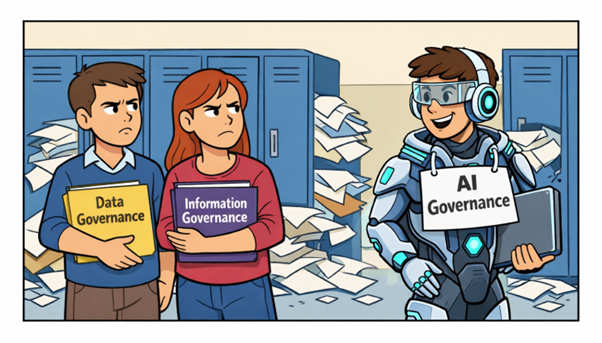
If you’ve spent time in governance, you may have noticed the emergence of three distinct disciplines—data governance, information governance, and now AI governance—each attempting to address similar challenges in managing information. These frameworks operate separately, with their own teams and languages, leaving businesses unsure about the differences among them.
Historically, governance began with physical records, ensuring that documents were stored, retrievable, and disposed of appropriately. With the digital transformation, data governance evolved to oversee data quality, integrity, lineage, and compliance across structured systems. Meanwhile, information governance developed alongside but often with different priorities and reporting lines. These two areas seldom communicated, despite sharing a common goal: to ensure that information is accurate, accessible, protected, and suitable for purpose.
Today, the landscape is shifting. AI models process everything—from structured data to unstructured documents, policies, and even emails—without distinguishing between data and information assets. This convergence necessitates a new collaborative approach among the three governance frameworks. Data governance provides the quality, lineage, and classification essential for trustworthy AI outputs. Information governance manages the unstructured data that AI systems prefer to consume, while AI governance relies on both foundations to tackle critical questions around data usage and accountability.
The challenge, however, is that many AI governance principles are not entirely novel; they extend existing discussions on data ethics, privacy, and responsible usage into the realm of machine learning and automated decision-making. If organizations are uncertain about what data trained their models and who is responsible for that data, the issue may lie not solely with AI governance but with underlying data and information governance frameworks that have yet to solidify.
While enterprise knowledge management is crucial for AI adoption, it should not be conflated with governance. Knowledge management—encompassing ontologies, semantic models, and shared business concepts—transforms raw information into something usable for both machines and humans. Governance responsibilities should set standards, accountability, and risk guidelines for how this knowledge is created and utilized, but the development of knowledge models should remain within the jurisdiction of data management teams.
The convergence of data and AI governance is already evident in the job market. An increasing number of roles now feature “Data & AI Governance” in their titles, signaling a trend where organizations are expecting one individual to bridge both areas. This duality makes sense; the individual responsible for data quality and classification must also understand the data feeding AI models, how it is utilized, and whether it is appropriate for use. The overlap in skills and stakeholder interests reinforces the notion that these governance roles are interconnected.
Looking ahead, the governance landscape may evolve into two primary disciplines: one for data governance and another for AI governance. Data governance would encompass all information assets, including those traditionally defined by information governance, while AI governance would focus on model oversight, ethics, accountability, and responsible usage, deeply integrated with data governance practices. This integration could potentially streamline efforts into a single framework, though some may argue for maintaining separate frameworks for regulatory reasons.
Moreover, the distinction between information governance and data governance appears increasingly tenuous. Many organizations are already merging these functions, as teams manage classification, retention, and metadata across all types of information. The historical separation of these disciplines was more relevant when data governance was limited to structured databases, but modern governance now includes both structured and unstructured data management. While some organizations may retain formal distinctions due to regulatory or structural requirements, the direction is clear: a unified approach to governing information, irrespective of its format, is emerging.
In conclusion, the future of governance appears to be headed towards an integrated model of data governance and AI governance, where information assets are managed comprehensively. Organizations that recognize this convergence early and adapt accordingly will likely find greater efficiency and effectiveness in their governance efforts. Those clinging to outdated, separate frameworks may continue to encounter challenges in managing their information landscapes.
See also Australia’s Attorney-General Advocates Licensing Deals Between AI and Creative Industries
 India Strengthens AI Content Regulations, Mandates Clear Labeling and Swift Action Against Deepfakes
 LiteLLM Faces Malware Scandal Post-Compliance Certifications from Delve Amid Security Concerns
 Designing Responsible AI: Key Insights from Clara Higuera on Ethics and Development