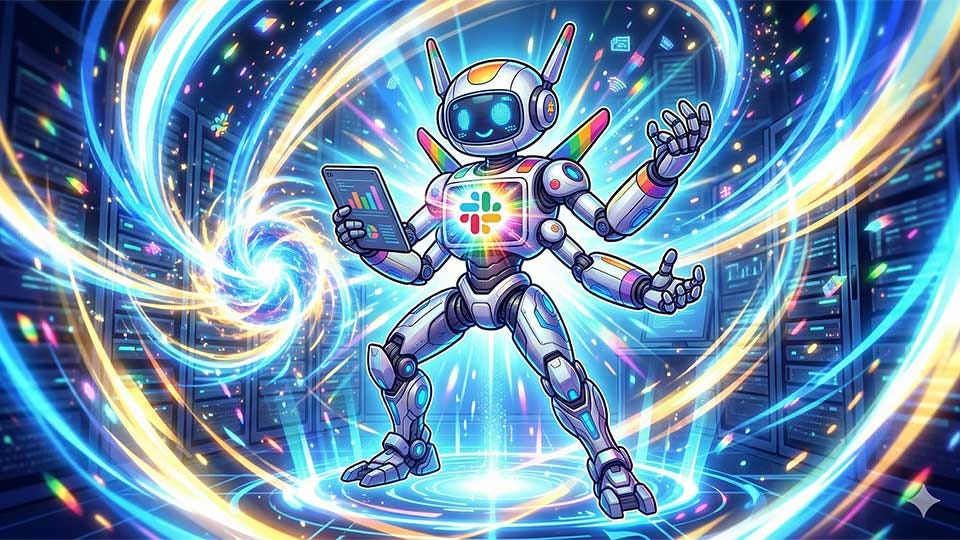
Salesforce’s Slack has taken a significant step in redefining workplace productivity with the evolution of its core feature, Slackbot. Originally designed as a basic assistant for reminders and simple automation, Slackbot is being transformed into what Salesforce now describes as the “ultimate teammate.” This change comes in tandem with the rise of artificial intelligence (AI) in workplace applications, reflecting a shift in how organizations view productivity tools.
For more than a decade, Slack has positioned itself as a central hub for team communication and collaboration. However, Slackbot had largely been overshadowed by the platform’s other features until its recent relaunch. In January, Salesforce equipped Slackbot with new capabilities, enabling it to function as a personal work assistant. The introduction of over 30 additional features last month marked a pivotal moment in its evolution, aligning with Salesforce’s vision of digital labor.
“With Slackbot, every employee now has a super-intelligent teammate whose status is always green—coordinating across teams and systems, accelerating execution across the enterprise, and saving hours every day,” said Parker Harris, Salesforce’s co-founder and Slack’s chief technology officer. According to Salesforce, the revamped Slackbot can help workers save up to 90 minutes each day, contributing to an impressive productivity gain of $6.4 million within its own organization.
The expanded capabilities of Slackbot include transcribing meetings, taking notes, and providing context across various applications, powered by Anthropic’s Claude model. This enhancement allows it to support deep research and voice inputs, adapting over time to better suit individual work styles. Salesforce has integrated features commonly found in third-party applications directly into Slackbot, thereby positioning it as a comprehensive tool for workplace efficiency.
Slackbot’s upgraded role is part of Salesforce’s broader strategy to make the team communication app a vital component in the era of AI. By bringing its own applications, such as Agentforce for sales and HR, into Slack, Salesforce is pushing to create a unified platform where employees can access everything they need through a single interface.
As AI capabilities become more prevalent in the workplace, Slackbot is being seen as an active participant in day-to-day operations rather than just a passive tool. In this way, it mirrors the evolution of workplace dynamics, where the integration of human and AI efforts is becoming increasingly important. “Together, Salesforce and Slack will give companies a single source of truth for their business,” the company stated regarding the benefits of this integration.
This shift from being solely a tool to being an active participant reflects a broader change in enterprise software. Tools are no longer defined just by their assistive capabilities; they are now expected to execute tasks autonomously and manage workflows. The evolution of Slackbot marks a crucial moment in this ongoing transformation, as it moves from the background to a more central role in facilitating productivity.
As organizations continue to embrace AI, Slackbot’s upgrade provides Salesforce a competitive edge against rivals like Microsoft, which has its own AI-driven agent, Microsoft Copilot. By positioning Slackbot as a comprehensive work assistant, Salesforce aims to showcase the capabilities of AI agents while reinforcing Slack’s role as the central operating system for the enterprise.
Ultimately, the reimagining of Slackbot illustrates a broader trend in the tech industry: software is becoming more proactive in managing workflows and executing tasks. As Slackbot continues to evolve, its success will likely depend on its ability to not only integrate seamlessly into daily routines but also to adapt to the changing landscape of work and communication.
See also AI Transforms Truck Maintenance: 400 Data Points Drive Proactive Diagnostics
 AI Programming Surge Creates 1M Lines of Code to Review, Heightening Security Risks
 Top AI Sales Tools of 2026: 8 Platforms Transforming Revenue Generation
 Adobe Summit 2026 Launches New AI Tools, Unveils Key Customer Experience Strategies
 STEINERT Unveils Advanced AI Sorting Solutions for Aluminium and PET at IFAT 2026