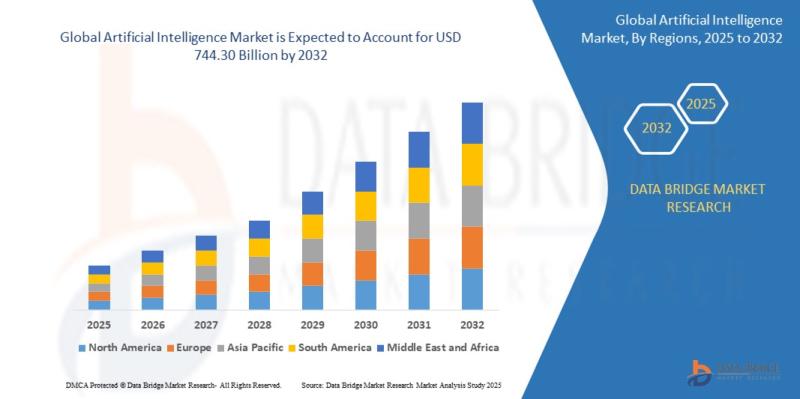
The global artificial intelligence (AI) market is poised for substantial growth, expanding from an estimated USD 185.20 billion in 2026 to USD 744.30 billion by 2032, according to a report from Data Bridge Market Research. This growth trajectory, representing a compound annual growth rate (CAGR) of 26.10%, is largely spurred by increasing demand for advanced automation, data-driven decision-making, and intelligent systems across various industries.
Key drivers of this expansion include rapid advancements in machine learning and deep learning technologies, along with heightened enterprise adoption of AI-powered solutions. Significant investments in digital transformation and a wide range of applications spanning healthcare, finance, retail, and manufacturing further fuel market development. Additionally, supportive government initiatives promoting AI innovation and the growing influence of big data analytics play a crucial role in enhancing market dynamics.
North America currently leads the market, holding over 38% of the revenue share, backed by a robust AI ecosystem and leading technology providers. The Asia-Pacific region, however, is the fastest-growing market, benefiting from rapid digitalization and substantial government backing for AI initiatives. The software segment remains the most significant market contributor, driven by the widespread deployment of various AI platforms and tools.
Within the industry, machine learning and deep learning applications are predominant, reflecting extensive enterprise adoption. Notably, the healthcare and banking, financial services, and insurance (BFSI) sectors emerge as leading end-use segments, propelled by increasing demand for predictive analytics and automation.
Market analysts highlight several key trends shaping the AI landscape. North America’s lead in the global AI market is attributed to its advanced infrastructure and considerable research and development investments. Conversely, the Asia-Pacific region is witnessing rapid growth, fueled by large-scale data generation and expanding digital economies. The integration of AI with the Internet of Things (IoT) and cloud computing is also expected to enhance scalability and operational efficiency across various sectors.
Despite these favorable trends, several challenges remain for the AI market. High implementation and operational costs pose significant barriers, particularly for small and medium enterprises that may lack the necessary financial resources. Concerns surrounding data privacy and security further complicate the landscape, with stringent regulations like the General Data Protection Regulation (GDPR) in Europe creating compliance challenges. Additionally, a shortage of skilled professionals in AI-related fields restricts innovation and slows implementation.
Opportunities for growth abound, particularly in emerging economies where rapid urbanization and industrialization create demand for AI solutions. The emergence of generative AI technologies is also expected to open new avenues in content creation and customer engagement, particularly in North America and Europe. Moreover, the ongoing integration of AI in healthcare and life sciences promises transformative impacts in diagnostics, drug discovery, and personalized medicine, highlighting the sector’s long-term revenue potential.
In terms of market dynamics, competitive pressures are significant, with numerous global and regional players vying for dominance. The market is characterized by high innovation intensity, where companies strive to differentiate through advanced AI capabilities. Major industry players such as Microsoft Corporation, Google LLC, Amazon Web Services, IBM Corporation, and NVIDIA Corporation lead the charge, focusing on product innovation and strategic partnerships to enhance their competitive edge.
The landscape is also witnessing emerging players and startups that introduce specialized AI solutions, contributing to increased competition and innovation. Recent developments in the sector reflect this trend, with companies like Meta Platforms, Inc. and Oracle Corporation investing in advanced AI research and capabilities, further reshaping the competitive landscape.
Looking ahead, the AI market is set for continued evolution as organizations across sectors leverage AI technologies for improved efficiency and productivity. The collaborative efforts between technology providers and industry stakeholders are expected to accelerate the pace of innovation, setting the stage for a dynamic and rapidly expanding AI ecosystem.
See also Alpha Compute Appoints Tom Richer to Advisory Board to Strengthen AI Infrastructure Strategy
 Autodesk Donates $1.95M to Howard University for AI-Driven Engineering Education
 Forge Nano Plans $1.6 Billion SPAC Merger to Accelerate AI Chip Production
 Apple’s New CEO John Ternus Faces Major Challenges Ahead of WWDC AI Reveal
 Apple Names John Ternus CEO as Mobile Phones Shift Toward AI-Driven Interaction Systems