






















































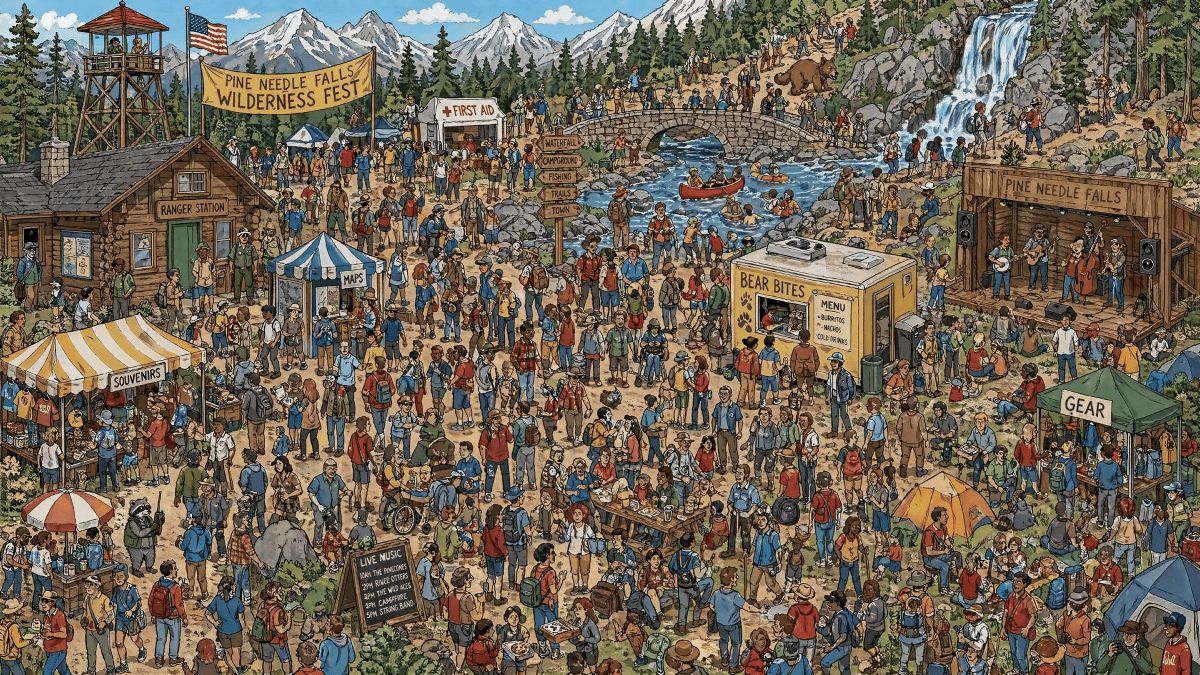
OpenAI has officially launched ChatGPT Images 2.0, an advanced image generation feature for its ChatGPT platform, on April 22, 2026 (Japan time). This latest update allows users to create intricate illustrations, significantly enhancing the capabilities of AI in visual content generation. Software engineer Simon Willison has shared his experiences using ChatGPT Images 2.0 and other image generation AIs to recreate images reminiscent of the beloved children’s book series ‘Where’s Waldo?’, providing a critical benchmark for this technology.
The original “Where’s Waldo?” concept involves locating the character Waldo, known for his iconic red and white stripes, hidden within detailed scenes. In his experiment, Willison prompted various image generation AIs with the request, “Create a Where’s Waldo style image, but where is the raccoon holding a ham radio?” His goal was to see how well these models could incorporate specificity while maintaining the signature complexity of the original illustrations.
As a benchmark, Willison first utilized OpenAI’s previous model, gpt-image-1. While the resulting illustration was visually appealing, it suffered from notable distortions in details, particularly in the character’s facial features and limb proportions, making the raccoon challenging to identify. Even after a thorough analysis, Willison could not locate the targeted raccoon among the depicted crowd.
Next, he turned to Claude Opus 4.7, an AI renowned for its high-resolution output. Despite its advanced capabilities, Claude also fell short, acknowledging it could detect at least one raccoon but struggled to pinpoint the one holding the ham radio. “There is at least one raccoon in the photo, but it is very well hidden,” the AI reported, illustrating the challenges of this type of image generation.
Continuing his exploration, Willison then tested the Nano Banana 2 AI via Google’s Gemini platform. This image featured a raccoon prominently stationed in the “Amateur Radio Club,” clearly depicted but lacking the concealment characteristic of “Where’s Waldo?” Similarly, an image generated by Nano Banana Pro placed a large raccoon holding a ham radio front and center, echoing Waldo’s signature look but notably larger than the surrounding characters, thus losing the element of discovery.
Finally, Willison employed the newly released ChatGPT Images 2.0 to generate an image with a resolution of 3840 x 2160 pixels. The outcome was a marked improvement; the raccoon with the ham radio was skillfully hidden in the lower left corner, seamlessly blended into its environment. Willison noted that this model exhibited significantly higher quality than its predecessors, highlighting the advances made in AI-driven image generation. The process used 13,342 tokens, with a cost of approximately 40 cents (about 64 yen) per image.
Reflecting on his findings, Willison remarked, “I think this new ChatGPT image generation model has taken the throne from Gemini, at least for now. Images like ‘Where’s Waldo?’ are a frustrating and somewhat silly way to test these models, but they help show how much the ability to generate complex illustrations that combine text and details has improved.” His observations underscore the rapid advancements in AI technologies, particularly in their ability to create increasingly sophisticated visual content.
This development positions OpenAI’s ChatGPT Images 2.0 as a significant player in the evolving landscape of image generation tools, raising intriguing possibilities for future applications in creative fields. As AI continues to enhance its capabilities, the use of these technologies in educational, entertainment, and artistic contexts is likely to expand, prompting both excitement and critical discussion about the ethical implications of AI-generated imagery.
See also OpenAI Unveils ChatGPT Images 2.0, Enhancing Text Accuracy and Resolution Up to 2K
 Intel Launches vllm-0.14.0-b8.2 with Official Support for Arc Pro B70 GPU
 OpenAI’s RealityForge 2.0 Launches, Surging AI Video Content by 40% in One Week














