Myriad Genetics has partnered with the AWS Generative AI Innovation Center to enhance its healthcare document processing capabilities, aiming to tackle inefficiencies that have plagued its operations. The collaboration leverages Amazon’s Generative AI technologies, specifically Amazon Bedrock and the GenAI Intelligent Document Processing (IDP) Accelerator, to automate and optimize workflows that involve handling complex medical documents. This strategic move comes as healthcare organizations increasingly face challenges in managing the growing volumes and complexities of medical documentation.
Myriad’s Revenue Engineering Department processes thousands of healthcare documents daily, including Test Request Forms, Lab Results, Clinical Notes, and Insurance documents. Previously, the company utilized Amazon Textract for Optical Character Recognition (OCR) and Amazon Comprehend for document classification. While this system achieved a classification accuracy of 94%, it incurred operational costs of 3 cents per page, leading to monthly expenses upwards of $15,000 per business unit. Moreover, the classification process had a latency of 8.5 minutes per document, creating delays in prior authorization workflows.
With the increase in document volume, Myriad found its existing processes cumbersome and costly. The manual extraction of key information, such as patient data and insurance details, required substantial human resources, particularly in the Women’s Health division. To alleviate these bottlenecks, Myriad sought a more efficient solution that would not only reduce costs but also accelerate processing times and automate information extraction across its various business units.
Transformative AI Solutions
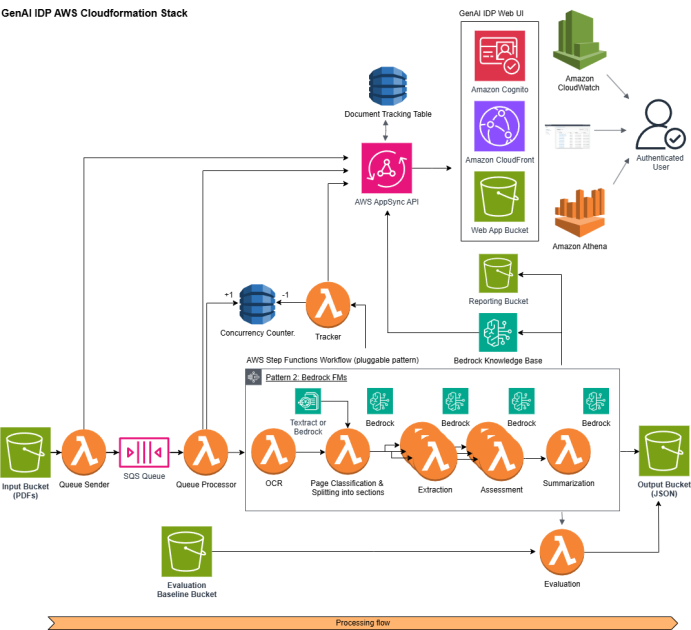
In response to these challenges, Myriad turned to the AWS Generative AI Innovation Center, which introduced innovative methodologies utilizing modern large language models (LLMs). By employing Amazon’s foundation models, such as Amazon Nova Pro for document classification and Amazon Nova Premier for information extraction, Myriad could significantly enhance both speed and accuracy. This transition included the implementation of the GenAI IDP Accelerator, a scalable and serverless architecture designed to convert unstructured documents into structured data.
The accelerator allows for the parallel processing of multiple documents while managing concurrency limits, thereby optimizing resource use. It features a built-in evaluation framework to iteratively improve accuracy, providing organizations like Myriad with a flexible and efficient solution. By customizing document classes, key attributes, and processing logic through a user-friendly interface, Myriad adapted the system to meet its specific needs without extensive coding.
During implementation, Myriad’s team focused on optimizing prompt engineering techniques to enhance document classification. Through detailed analysis and contextual understanding, they improved the system’s ability to differentiate between similar documents, increasing classification accuracy to 98%. This was achieved while reducing processing costs by 77% and speeding up classification times significantly—from 8.5 minutes to just 1.5 minutes per document.
Furthermore, the automation of Key Information Extraction, which previously demanded considerable manpower, transformed operational efficiency. By enhancing OCR configurations and implementing advanced reasoning capabilities, the new system achieved extraction accuracy on par with manual processes, all while processing documents in about 1.3 minutes each.
As Myriad prepares for a phased rollout, starting with the Women’s Health division and extending to Oncology and Mental Health, the projected annual savings from these initiatives could reach $132,000. The improvements not only streamline workflows but also enhance the speed at which healthcare professionals can access critical information, reducing the time taken for prior authorization submissions by two minutes.
Martyna Shallenberg, Senior Director of Software Engineering at Myriad Genetics, emphasized the transformative nature of this partnership, stating, “Partnering with the GenAIIC to migrate our Intelligent Document Processing solution from AWS Comprehend to Bedrock has been a transformative step forward.” She underscored the importance of collaboration in driving measurable business impact and improving operational capabilities.
This case exemplifies how generative AI can significantly enhance healthcare operations, addressing the complexities of document processing in a rapidly evolving industry. As healthcare organizations continue to adapt to growing demands, solutions like those developed by Myriad and AWS may well define the future of efficient and effective patient care.
For organizations looking to replicate Myriad’s success, the GenAI IDP Accelerator is publicly available, allowing for an exploration of how advanced AI technologies can be integrated into existing workflows. This offers a pathway for improved operational efficiency, ultimately benefiting both providers and patients alike.
For more information on Myriad Genetics, visit Myriad Genetics. Learn more about AWS services at AWS.
See also Microsoft Faces Setback as Two Senior AI Leaders Depart Amid Data Center Struggles
 Amazon Warns Customers of Rise in AI-Powered Account Scams Targeting Personal Data
 UN Unveils Comprehensive AI Governance Framework to Enhance Global Cooperation and Human Rights
 Dan Ives Declares Microsoft a ‘Table-Pounder’ Amid AI Growth, Highlights Alphabet’s 70% Surge
 World Leaders Establish Groundbreaking Global AI Regulation Pact for Safety Standards