






















































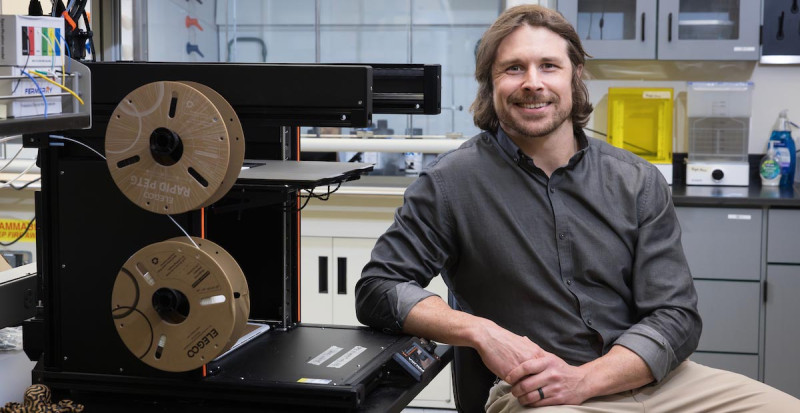
The world of polymers, the long, string-like molecules that form the basis of many everyday materials, is often complicated. From the plastics in our water bottles to the tissues in our bodies, polymers exhibit a range of mechanical properties, including stretchiness, softness, and stiffness. However, the relationship between the molecular structure of these materials and their observable qualities is not always clearly understood. Assistant Professor Robert Wagner, a faculty member at the Thomas J. Watson College of Engineering and Applied Science’s Department of Mechanical Engineering, aims to bridge this gap. Recently awarded a National Science Foundation CAREER Award, Wagner will receive $569,573 to research how molecular behavior informs the mechanical properties of polymers using machine learning and experimental techniques.
“Our group is all about bridging those scales,” Wagner said. “It’s really important because not only will it give us a better understanding of how materials work — like what physics drives their mechanical properties — but it will also help us with predictive design.” His research could have wide-ranging implications, including informing the design of stronger, stiffer materials tailored for specific applications.
Wagner’s focus centers on how polymers can be chemically bonded or physically entangled. When entanglements outnumber chemical cross-links, the resulting materials can become significantly tougher, with resistance to breakage increasing by up to three orders of magnitude. He theorizes that in physically entangled polymers, the stress from a break in a single chain dissipates across a larger area of the network, preventing crack propagation and enhancing toughness.
This understanding could be pivotal for a variety of applications, from everyday rubbers and adhesives to sophisticated biomedical devices and soft robotics. For example, in the realm of biomimetic tissue implants, entangled polymers may be crucial for developing hydrogels that mimic the mechanical properties of natural tissues, enabling the effective transport of nutrients and waste products. “We want to design materials that optimize stiffness, strength, and toughness without making them brittle,” Wagner explained.
Currently, studying entanglements poses a challenge for researchers. Traditional methods rely on molecular dynamics models that simulate polymer chains as beads connected by springs, offering high-resolution insights yet requiring extensive computational resources. In his CAREER project, Wagner proposes a novel approach using machine learning to recognize and characterize entanglement patterns more holistically. Instead of focusing on each individual chain, his research team plans to develop graph neural networks that can predict how one entangled network will behave mechanically compared to another, thereby reducing computational demands.
“Polymers are networked materials, and therefore we should be able to represent them as graphs,” Wagner noted. He aims to validate these models through physical experiments on hydrogel samples his team will synthesize in-house. The goal is to understand the underlying physical mechanisms driving macroscopic observations, enhancing engineers’ ability to predictively design new materials while also advancing fundamental science.
Educating Future Engineers
Beyond his research, Wagner is committed to outreach and education, particularly targeting underserved populations. He plans to bring his findings into K-12 classrooms through hands-on demonstrations and is also focusing on educational initiatives for incarcerated students. By partnering with the company behind MATLAB, he aims to equip computer labs in correctional facilities, starting with the Cayuga Correctional Facility. “Instead of the hands-on demonstrations we can take to K-12 environments, we’re going to use computer simulations to teach concepts,” he said.
Wagner’s multifaceted approach to education and research underscores his belief in being both a teacher and a learner. “Every time I teach something, I feel like I understand it better,” he remarked. With his CAREER proposal marking a significant step in addressing complex engineering challenges, Wagner is optimistic about the future of his research and its potential applications. “Now we have to do the work,” he said. “This is very much the first stepping stone to what will hopefully be a very productive body of work.”
See also Pharos Network Launches $10M AI-Prediction Market Research Project with HKU
 Pennsylvania Universities Form Keystone AI + Quantum Factory to Boost Supercomputing Collaboration
 Young Innovators Transform Robotics with Affordable Dexterous Hands, Driving Industry Change
 Pennsylvania Launches Keystone AI + Quantum Factory to Propel Statewide Tech Innovation
 Gizmo AI Learning App Surpasses 13 Million Users, Raises $22 Million for Adaptive Quizzes






