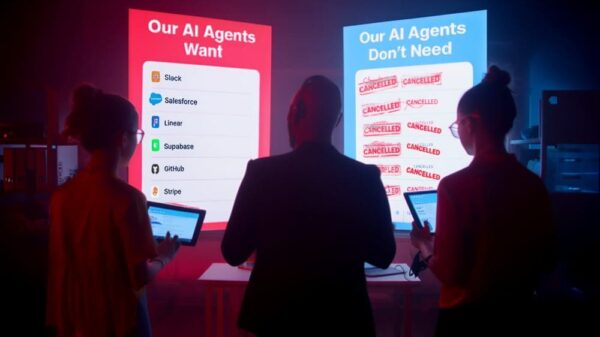
As the landscape of enterprise technology shifts, industry leaders are questioning the necessity of traditional software systems like Salesforce. Rao, a former consultant, highlights a growing trend towards automation that challenges the existing workflows that typically require agents to log information into platforms like Salesforce. “Right now we’re blindly automating the existing workflow,” he notes, suggesting that this approach may be insufficient as organizations seek to streamline their value chains.
Rao argues for a more nuanced understanding of technology integration, emphasizing that action items from meetings could be automatically identified and addressed without placing data into cumbersome systems. He believes this shift poses a significant threat to established vendors such as Salesforce, SAP, and Workday, which have long dominated the market.
The conversation around the so-called “agentic economy” introduces another layer of complexity. Instead of requiring human employees to interact directly with vendor AIs, companies could increasingly rely on their own agents to manage these conversations, effectively simplifying vendor transitions for employees. Ricardo Baeza-Yates, co-chair of the US technology policy committee at the Association for Computing Machinery, supports this view, predicting that such changes will enhance market competitiveness and facilitate easier integrations.
However, experts caution against overcomplicating systems at this juncture. Bret Greenstein, Chief AI Officer at West Monroe Partners, advises companies to leverage existing vendor agents rather than develop their own intricate systems. “If you build a highly complicated system, you’re going to be building yourself some tech debt,” he warns. Yet, he notes that as technology advances, the potential for independent agents that can function outside the confines of existing applications is increasing.
The shifts in enterprise software pricing models are also notable. According to IDC, traditional seat-based pricing structures are expected to become obsolete by 2028, prompting about 70% of software vendors to reevaluate their business strategies. Tull from JBGoodwin Realtors illustrates this evolving mindset, indicating that the firm is now more inclined to seek flexible contract options despite previously favoring long-term agreements.
This does not imply that Software as a Service (SaaS) will fade away immediately. Companies have invested heavily in their current tech infrastructures, and as Patrycja Sobera, Senior Vice President of digital workplace solutions at Unisys, points out, organizations are not abandoning their cloud and SaaS strategies outright. “I’m not seeing that at all,” she states, highlighting the cautious approach many businesses are taking.
Change is inherently slow, particularly within larger institutions that often cling to legacy systems. For instance, the Federal Aviation Administration (FAA) recently announced a major initiative to update its technology, aiming to replace outdated systems such as floppy disks and Windows 95—a process projected to take four years. Such examples illustrate the challenges organizations face as they grapple with the pace of technological advancement.
Looking ahead, the industry appears poised for a significant evolution toward agent-based systems, which could reshape funding, innovation, and software economics. Sobera emphasizes that as more organizations strive to “cross the chasm” to embrace these changes, varying levels of maturity will emerge. While some firms may remain anchored in the SaaS mentality, others are already reaping the rewards of early adoption, outperforming peers in key metrics like revenue and innovation.
See also AI Expert Sam Leffell Evaluates Google’s $20 Polish Feature Amid ChatGPT Comparison
 Spacetools Achieves 12% Boost in Spatial Reasoning with Double Interactive Reinforcement Learning
 ECI Software Solutions Launches Payments Division and AI Tools, Boosting SMB Cash Flow
 Microsoft Unveils AI Tools to Drive $1B Digital Transformation in Philippines