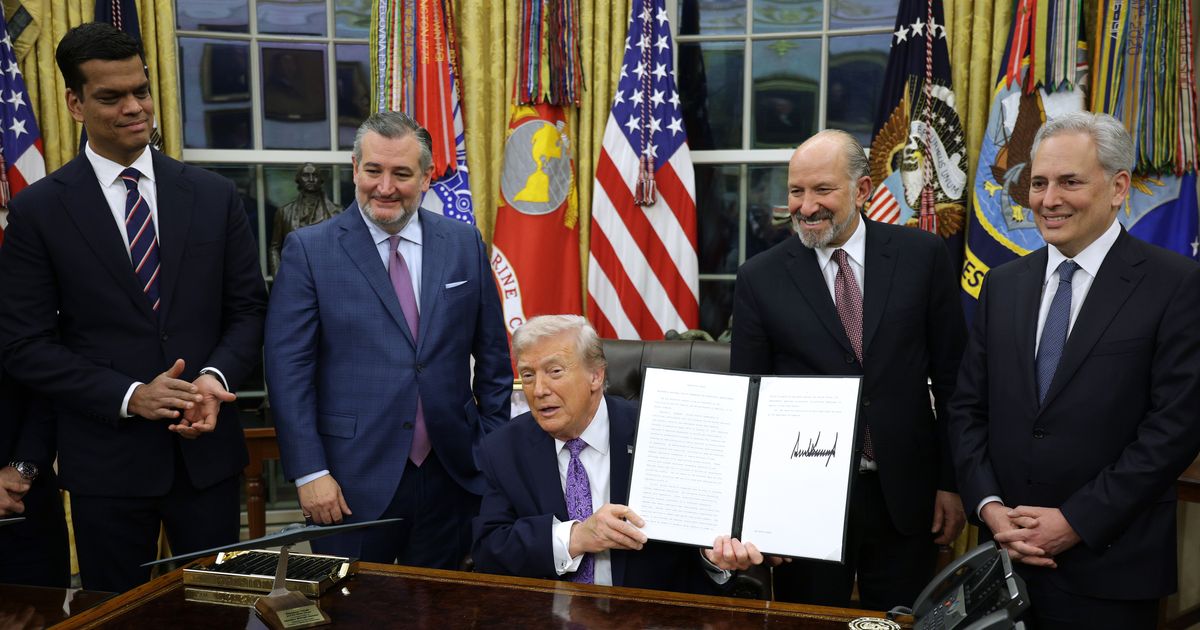
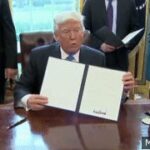
WASHINGTON – President Donald Trump signed an executive order Thursday aimed at preventing states from regulating artificial intelligence (AI), arguing that a patchwork of state laws could hinder the United States in the race to develop technology that may outpace human intelligence. This action follows Congress’s repeated reluctance to address state AI regulations, most recently illustrated by a military spending bill passed by the House on Wednesday, which lacked such provisions.
The executive order has faced bipartisan criticism, with concerns raised over unchecked corporate power, rising energy prices, and potential infringements on states’ rights. Trump emphasized the urgency of the situation, stating, “There’s only going to be one winner here, and that’s probably going to be the U.S. or China,” adding that securing 50 different state approvals would be impractical for companies seeking to innovate.
Legal challenges to the executive order are anticipated, highlighting an ongoing reality: Congress has struggled to regulate tech companies, leaving the U.S. in a sort of technological Wild West. This environment allows businesses to thrive while states and individuals grapple with issues related to unrestrained data collection and the burgeoning AI sector. Notably, the U.S. remains the only developed nation without a comprehensive national law governing how companies can collect and utilize personal data, leaving Americans among just 18% of the global population without such protections.
In recent years, there has been mounting pressure for a unified national data privacy law. Former Rep. Cathy McMorris Rodgers, R-Spokane, sought to prioritize this issue before her retirement in 2024, collaborating with Sen. Maria Cantwell, D-Wash., to propose a bipartisan bill that gained traction. However, this effort faced significant opposition from industry lobbyists and was ultimately sidelined when House Speaker Mike Johnson and House Majority Leader Steve Scalise intervened to block the legislation.
Concerns extend beyond data privacy. Parents and tech whistleblowers have raised alarms regarding children’s safety online, highlighting how social media platforms and other content can adversely affect youth mental health. A Pew Research Center report revealed that a majority of American teenagers engage with video apps like YouTube and TikTok daily, with 21% on TikTok “almost constantly,” despite nearly half of them perceiving social media as having a “mostly negative” influence.
The Senate endorsed the Kids Online Safety and Privacy Act in July 2024, yet partisan divisions stalled its progress in the House, where Johnson cited free speech concerns. As the U.S. grapples with these regulatory challenges, Australia has taken systematic steps to protect youth online, recently enforcing a ban on social media usage for individuals under 16. This law marks a significant move in tech regulation and accountability, requiring platforms to compensate local news outlets for published content. Meanwhile, similar initiatives in the U.S. aimed at addressing local news crises have repeatedly failed in Congress.
Trump’s administration has openly supported the rapid growth of AI, which accounted for nearly all U.S. economic growth in the first half of 2025, according to Harvard economist Jason Furman. His administration has cultivated a close relationship with Jensen Huang, CEO of Nvidia, the chipmaker now valued as the world’s most valuable company for producing the semiconductors essential to advanced AI systems. As data centers proliferate, driving up energy costs nationwide, state legislatures have introduced numerous bills and enacted approximately 100 regulations pertaining to AI this year.
Rep. Michael Baumgartner, R-Spokane, has introduced a bill that mirrors Trump’s executive order, aiming to prevent state-level AI regulations. Trump’s signed order includes exceptions, allowing states to legislate regarding children’s safety, data centers, and their own use of AI tools. Baumgartner expressed concern that without federal standards, states could inadvertently cede regulatory control to California or the European Union, arguing that the AI race is crucial for U.S. national security.
“If Washington and Oregon team up with California, the size of the market is so big that if we don’t take action at the federal level, that is de facto granting the regulation of AI to California,” he stated. On Friday, senior White House adviser for AI, Sriham Krishnan, indicated that the administration intends to collaborate with Congress to establish national AI standards.
For such legislation to succeed, cooperation between Trump and Democrats is essential, particularly given skepticism surrounding the legality of the executive order. Any new law would require bipartisan support in the Senate, where 60 votes are generally needed to pass most bills, while Republicans hold a narrow majority in the House. The unfolding dynamics of AI regulation will likely shape the landscape of both technology development and governance in the United States in the coming years.
See also Trump Announces Executive Order to Standardize AI Regulation Nationwide
 Trump Signs Executive Order to Federalize AI Regulation, Threatens States with Funding Cuts
 Trump’s Executive Order on AI: Misguided Belief in Winner-Take-All Competition
 Trump’s AI Executive Order Faces State Resistance and Legal Challenges Ahead of 2026
 Trump Signs AI Executive Order to Centralize Regulation Amid Industry Debate