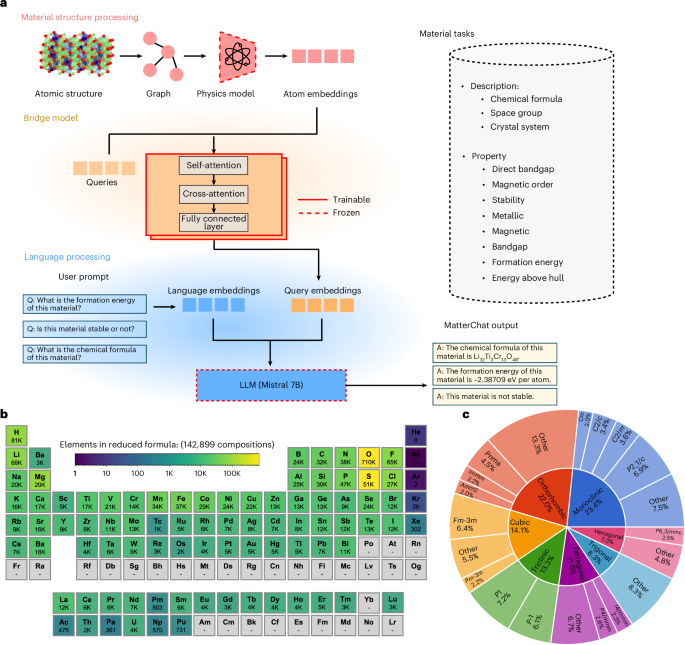
MatterChat, a cutting-edge multimodal large language model (LLM) developed to enhance materials science inquiries, integrates deep learning techniques to analyze material structures and interpret user queries effectively. The model, capable of tasks such as material property prediction and structural analysis, relies on a sophisticated architecture comprising three primary components: the material processing branch, the language processing branch, and a bridge model that connects the two.
The material processing branch encodes complex material structures as graphs, utilizing state-of-the-art encoder modules from universal machine learning interatomic potentials (MLIPs) like CHGNet and MACE. These encoders, pretrained on a diverse dataset of over 142,000 samples, extract atomic-level embeddings that capture essential features, such as atomic types and chemical bonds. This foundational step ensures the accurate representation of materials at the atomic level, laying the groundwork for subsequent analysis.
Complementing this is the language processing branch, which employs the Mistral 7B LLM to convert user prompts into dense embeddings. This model has been recognized for its exceptional performance across various scientific tasks. By transforming text-based queries about material properties—ranging from chemical formulas to stability predictions—into embeddings, the model facilitates a streamlined interaction process, allowing for precise responses to user inquiries.
Integration and Performance
Central to MatterChat’s functionality is the bridge model, inspired by the BLIP2 architecture. This component employs a multilayer transformer framework with 32 trainable query vectors that refine atom embeddings into query embeddings aligned with textual data. Through alternating attention mechanisms, the model enhances the representational depth of these embeddings, ultimately allowing for the generation of meaningful text outputs based on the combined structural and textual data. This integration is crucial for delivering accurate and contextually relevant responses.
The model’s effectiveness is underscored by its ability to respond to a spectrum of queries, as illustrated through various examples of human-AI interactions. MatterChat demonstrated proficiency in answering questions related to fundamental material attributes, such as chemical compositions and crystalline structures, while also addressing more complex material properties, including thermal stability and electronic characteristics. Notably, comparative evaluations highlighted MatterChat’s superior accuracy in estimating formation energies against commercial LLMs, consistently aligning its predictions with established ground truths.
Moreover, MatterChat’s advanced reasoning capabilities extend to generating detailed synthesis procedures for materials, demonstrating a practical application of its deep learning framework. For instance, when queried about widely used materials like gallium nitride, MatterChat provided a comprehensive synthesis protocol aligned with established experimental standards, showcasing the model’s ability to apply domain-specific knowledge effectively.
To further enhance its predictive capabilities, MatterChat employs a multimodal retrieval-augmented generation (RAG) mechanism. This strategy allows the model to aggregate additional information from similar samples, thereby improving the robustness of its predictions across various tasks. The results indicate not only a strong performance in both classification and numerical property prediction tasks but also a clear advantage over traditional models, including physical ML frameworks.
As the field of materials science continues to evolve, the implications of MatterChat’s capabilities extend beyond mere technological advancement. By bridging the gap between structural data and natural language processing, this model stands to facilitate significant breakthroughs in materials research, potentially accelerating the discovery and application of novel materials. With ongoing developments and refinements, MatterChat could play a pivotal role in shaping the future landscape of materials science and engineering.
See also OSU Study Reveals AI Overreliance Threatens Cognitive Skills in STEM Students
 MIT Reveals Study Mapping AI Capacity in Central Eurasia to Guide Investment Strategies
 APOLLO AI Launches, Analyzing 25B Medical Events to Predict Future Diseases
 AI Framework by Jingyuan Yang Achieves Fairness-Performance Balance in Job Opportunities
 IBM Launches Chicago Quantum Hub, Creating 750 AI Jobs and Expanding MIT Research Lab