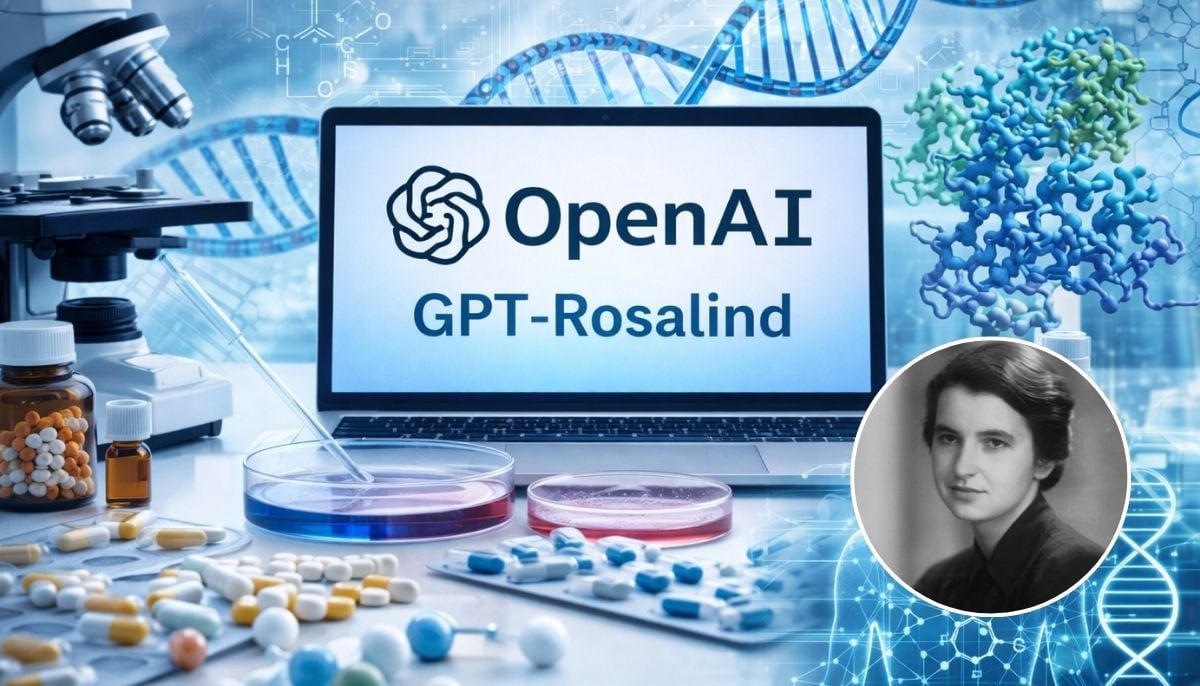
OpenAI has introduced a new artificial intelligence model named GPT-Rosalind Franklin, aimed at accelerating research in biology, drug discovery, and medicine. The model is named in honor of Rosalind Franklin, the British scientist whose work was pivotal in elucidating the structure of DNA.
GPT-Rosalind is engineered to manage intricate scientific tasks, integrating published research, biological data, laboratory tools, and experimental methodologies. It excels in reasoning about molecules, proteins, genes, and disease biology, making it a valuable asset for research endeavors.
The model is capable of navigating through complex scientific workflows, including literature reviews, genetic sequence analyses, experimental planning, and research data processing. According to OpenAI, the progress in life sciences is often hindered not only by scientific challenges but also by the inherent complexity of the research process. The company asserts that advanced AI can facilitate more efficient navigation through these workflows.
“We believe advanced AI systems can help researchers explore more possibilities and arrive at better hypotheses sooner,” OpenAI stated in its announcement. The company views GPT-Rosalind as the first step in a long-term commitment to developing AI that drives scientific discovery in areas critical to society.
OpenAI is collaborating with several significant entities in the biotech and pharmaceutical sectors, including Amgen, Moderna, the Allen Institute, and Thermo Fisher Scientific. Moderna’s CEO Stephane Bancel noted that the model is already demonstrating potential, emphasizing its ability to synthesize complex data and transform those insights into actionable experimental workflows, with the promise of expediting research and development timelines.
The unveiling of GPT-Rosalind is part of a broader initiative by OpenAI to enter the health and medical research domains. The company is actively developing new AI models and forming partnerships with global pharmaceutical firms. Recently, OpenAI announced a collaboration with Danish pharmaceutical giant Novo Nordisk, aiming to enhance the speed and efficacy of delivering new and improved treatments to patients.
OpenAI CEO Sam Altman remarked, “AI is reshaping industries, and in life sciences, it can help people live better, longer lives.” This statement encapsulates the transformative potential of AI technologies in healthcare and life sciences. As OpenAI continues to expand its footprint in these sectors, the introduction of GPT-Rosalind marks a significant milestone in the application of artificial intelligence to real-world scientific challenges.
The implications of GPT-Rosalind extend beyond mere research efficiency; they suggest a future where AI could unlock new understandings in biology and medicine, potentially leading to groundbreaking discoveries that could enhance human health. As the company forges ahead, the scientific community will be watching closely to assess how this innovative model can reshape drug discovery and biological research.
See also UNC’s AI-Enabled Ultrasound Gains FDA Clearance to Enhance Maternal Healthcare Access
 Guangdong Tech Firms Report 2025 Earnings: AI Drives Growth and Global Expansion
 AI Study Reveals Chatbots Generate Similar Ideas, Risking Creativity Diversity
 Meituan Launches Xiaomei AI Agent, Transforming Commerce with Seamless Delegation
 AI Use Linked to Declining User Confidence and Cognitive Abilities, Study Reveals