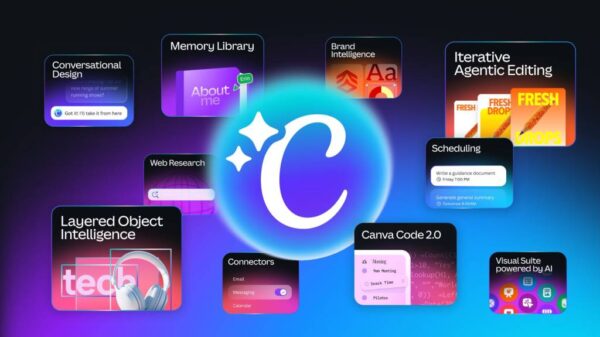
Canva has launched a significant update to its platform, Canva AI 2.0, at its Create event in Los Angeles. With an existing user base of 260 million and annual revenues of $3.5 billion, the company is evolving from its traditional role as a design tool. The new features introduced include conversational design, AI-generated templates, and more substantial functionalities such as recurring background task scheduling and integration with platforms like Slack, Gmail, Google Drive, Zoom, and Google Calendar. This shift positions Canva as a contender in the workflow automation space, a move that may redefine its classification as merely a design tool.
CEO and co-founder Melanie Perkins articulated the challenges Canva AI 2.0 aims to address, stating, “You generate something in one tool, format it in another, collaborate in a third, and publish through a fourth. Context gets lost between tabs, your brand guidelines live somewhere else entirely, and every extra step slows things down.” The update is poised to streamline various processes that often impede productivity in team environments.
The most notable addition, background task scheduling, allows users to automate recurring tasks. This feature can generate social media content on a set schedule, compile morning emails into briefing documents, or conduct web research and prepare reports without requiring user intervention. However, it is important to note that the scheduling feature only produces drafts for human review, preventing any automated publishing, which could limit its appeal for some IT teams.
Canva’s scheduling framework positions it against established players like Zapier and aspects of Microsoft Power Automate. The broader industry trend indicates a growing preference for tools that not only assist in workflows but also execute them autonomously. As outlined in recent analyses, the divide between these two categories is becoming crucial for enterprise purchasing decisions.
The newly introduced Connectors feature pulls data from applications such as Slack, Gmail, Google Drive, Zoom, Notion, and Google Calendar, unifying disparate systems into one execution layer. Use cases highlighted include generating meeting summaries from Zoom transcripts and converting customer emails into sales documents. As reported, a study by EY found that 78% of sellers missed their targets in 2025, largely due to inefficiencies caused by navigating disconnected systems. Canva’s approach aims to consolidate these tools rather than create additional data layers.
However, a potential risk remains: AI agents often succeed within individual platforms but can struggle with interoperability across different systems. IT teams will likely scrutinize Canva’s capability to uphold context and coherence across multiple connectors before fully committing to the platform.
The launch follows a series of strategic acquisitions, including Simtheory, an AI collaboration and agent management platform, and Ortto, a customer data and marketing automation firm. These acquisitions signal Canva’s intent to evolve from a design-centric platform to a more comprehensive AI platform integrated with design and productivity capabilities. COO Cliff Obrecht emphasized this transition, stating, “Simtheory accelerates our evolution from a design platform with AI tools to an AI platform with design and productivity tools at its core.”
Canva’s enterprise segment is expanding rapidly, with a 100% year-on-year growth rate, reporting $4 billion in annual recurring revenue (ARR) as of February 2026. The B2B segment alone is estimated to contribute around $500 million to this figure. A potential IPO is anticipated but remains unconfirmed. The market landscape is shifting as research from Gartner indicates that 40% of enterprise applications are expected to incorporate task-specific AI agents by the end of 2026, positioning Canva to capture a share of this emerging market.
The company is also navigating governance concerns as it implements agentic AI technologies internally, aiming to save 30,000 work hours. Its workforce recently engaged in a dedicated week of AI experimentation, enhancing the credibility of its offerings. However, as the integration of AI tools into email, calendar, and messaging systems expands, security and compliance issues arise. The draft-only functionality in scheduling mitigates some risks but does not fully address data access concerns among connectors.
In a further development, Canva has deepened its partnership with Anthropic, integrating Canva’s Design Engine into Claude, Anthropic’s AI assistant. This integration allows users to manipulate outputs from Claude as editable designs within Canva, effectively transforming the platform into a design execution layer that works in conjunction with various AI services. Perkins encapsulated this vision, stating, “We believe the next era of creation will be a world where ideas move from concept to finished work in a single, seamless flow, with your team, your context, and your brand built in from the very start.”
The research preview of Canva AI 2.0 is rolling out to the first million users today, with broader availability expected in the coming weeks, marking a pivotal moment in the ongoing evolution of the platform.
See also HubSpot Launches AI Answer Engine Optimisation Tool Amid 27% Search Traffic Decline
 Zenskar Secures $15M to Enhance AI Billing Automation for Complex B2B Pricing
 42% of Moroccan Workers Share Sensitive Data with External AI Tools, Kaspersky Reports
 Top 10 AI Payroll Tools Automate Salary Processing and Tax Filing for Small Businesses