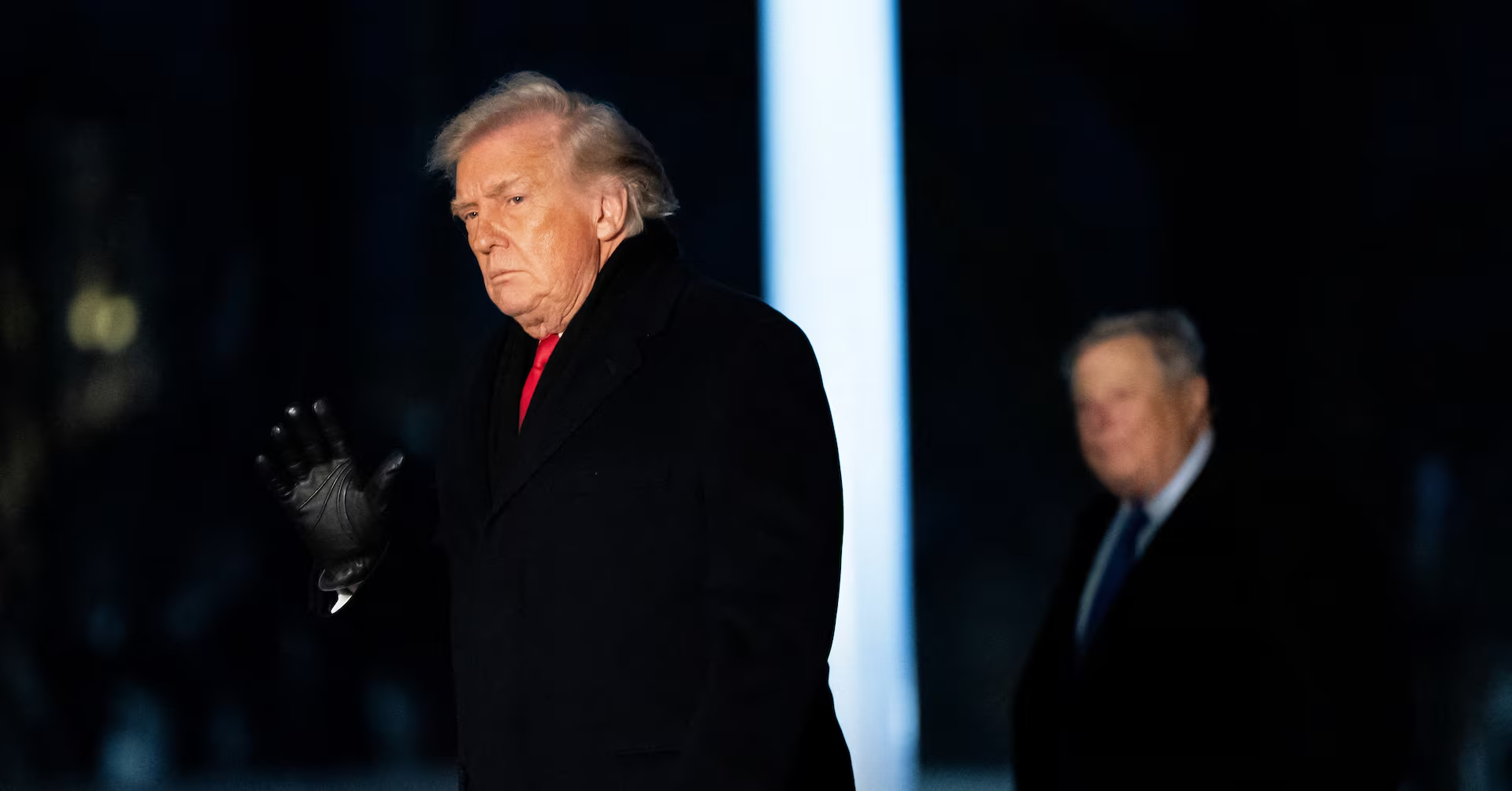
U.S. President Donald Trump reiterated his ambitions to assert control over Greenland, signaling potential disruptions to NATO unity and transatlantic trade relations. During a news conference on January 20, Trump declared there was “no going back” on his goal, even suggesting the possibility of military action. His comments come as he prepares to meet with European leaders at the World Economic Forum in Davos, Switzerland, amid a backdrop of growing tensions between the U.S. and its NATO allies.
“We will work something out where NATO is going to be very happy and where we’re going to be very happy,” Trump stated, alluding to ongoing discussions regarding Greenland’s status. His statements, however, raise concerns about the transatlantic alliance that has historically underpinned Western security.
Trump has leveraged social media to promote his vision for Greenland, sharing mock-up images of himself on the island, asserting its importance for “National and World Security.” In a post on Truth Social, he remarked, “Greenland is imperative for National and World Security. There can be no going back — On that, everyone agrees!” This rhetoric has alarmed European leaders, particularly as Denmark, a NATO member, has rebuffed Trump’s overtures.
Danish Prime Minister Mette Frederiksen responded defiantly, emphasizing that she would not abandon Greenland. “The American president has unfortunately not ruled out the use of military force. And therefore the rest of us cannot rule it out either,” she stated. This stark warning reflects the delicate balance of diplomacy and military posturing in the region.
In parallel, French President Emmanuel Macron, while at the World Economic Forum, urged European leaders to maintain their dignity in the face of external pressures, stating, “We do prefer respect to bullies.” Macron’s comments underscore a broader sentiment among European leaders who are increasingly wary of U.S. unilateralism under Trump’s administration.
Meanwhile, European Commission President Ursula von der Leyen has called for a new, more independent Europe, suggesting that recent geopolitical developments necessitate a reevaluation of transatlantic dependencies. As the EU contemplates its response, it has threatened retaliatory trade measures, including potential tariffs on approximately €93 billion ($109 billion) of U.S. imports, set to activate on February 6 if diplomatic avenues fail.
Macron also highlighted the possibility of invoking the EU’s “Anti-Coercion Instrument,” a tool designed to combat economic pressure exerted by other nations, including the U.S. This instrument, never before utilized, could impose restrictions on U.S. tech firms operating in Europe if tensions escalate further.
The implications of Trump’s Greenland ambitions extend beyond diplomatic rhetoric; they could reignite a trade war reminiscent of last year’s turmoil that rattled global markets. Scott Bessent, Trump’s Treasury Secretary, dismissed concerns as “hysteria,” yet market reactions suggest heightened anxiety. Major Wall Street indexes experienced significant declines, and gold prices surged to record highs, reflecting a flight to safety amid uncertainty.
Russia’s foreign minister, Sergei Lavrov, weighed in on the situation, asserting that “Greenland is not a natural part of Denmark,” while denying any intent to capitalize on the U.S.-Europe discord. Lavrov’s comments highlight the strategic interests various global players have in the Arctic region, where geopolitical competition is intensifying.
As Trump prepares for further discussions on Greenland in Davos, the potential for a resolution remains uncertain. European leaders, while projecting unity, must navigate the complexities of national security and economic stability amid a shifting global landscape. With trade tensions looming and NATO’s cohesion at risk, the stakes have never been higher for transatlantic relations.
For more information on U.S. foreign policy, visit the White House. To learn about NATO’s historical role, check out NATO’s official site. For insights on EU independence, see the European Commission’s website.
See also Anthropic Reveals Three Vulnerabilities in Git MCP Server Threatening LLM Integrity
 Balena Secures Strategic Investment from LoneTree Capital to Accelerate Edge AI Growth
 AI-Driven Immunotherapies Revolutionize Personalized Cancer Treatment, Boosting Survival Rates by 30%
 Gates and OpenAI Launch $50M AI Health Initiative to Boost African Healthcare Access
 CEOs Ramp Up Cybersecurity Investments Amid 66% Trust Concerns in Data and AI Safety