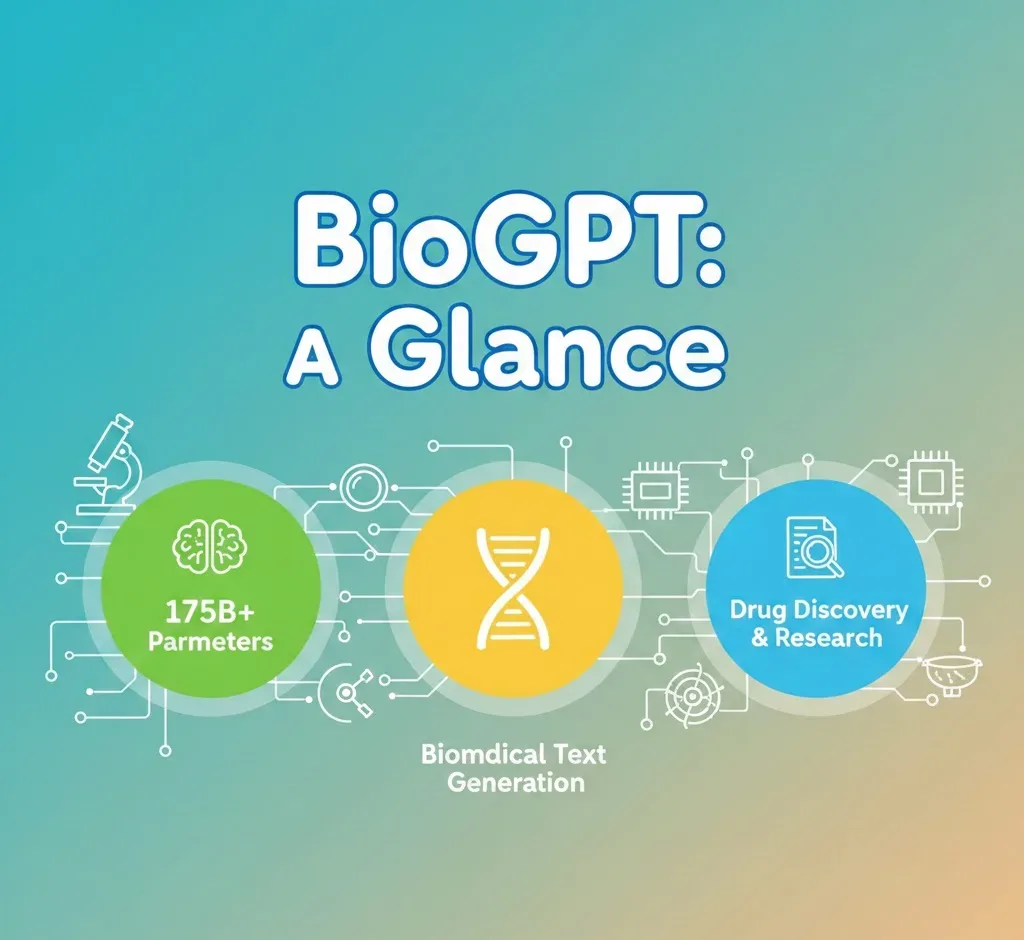
Microsoft’s BioGPT has emerged as a leading biomedical language model, recording 45,315 monthly downloads on Hugging Face as of December 2025. Since its launch in October 2022, this advanced AI model features 347 million parameters and was trained on 15 million PubMed abstracts, achieving an impressive accuracy of 78.2% on the PubMedQA biomedical question answering benchmarks. This growth comes at a time when the global AI healthcare market is experiencing significant expansion, rising from $26.69 billion in 2024 to projected growth of $613.81 billion by 2034.
With a sophisticated architecture comprising 24 transformer layers and 1,024 hidden units, BioGPT processes information through 16 attention heads, utilizing a vocabulary of 42,384 tokens geared towards medical terminology. The model was developed using a GPT-2 decoder architecture, optimized specifically for biomedical text generation. Training lasted approximately ten days, leveraging distributed GPU infrastructure with eight NVIDIA V100 GPUs, and involved 200,000 steps to achieve peak performance.
Developer engagement with BioGPT has been robust, with the model’s GitHub repository amassing over 4,500 stars and 475 forks. This interest underscores the model’s relevance in the biomedical natural language processing community, as evidenced by 129 BioGPT-tagged models available on Hugging Face. Community contributions have led to the development of 63 fine-tuned derivatives of BioGPT, which cater to specialized applications such as drug discovery literature mining and clinical documentation assistance.
Microsoft evaluated BioGPT across six biomedical NLP datasets, where it established benchmarks by surpassing existing systems, achieving 78.2% accuracy on PubMedQA. In relation extraction tasks, the model demonstrated F1 scores of 44.98% for chemical-disease relations, 38.42% for drug-target interactions, and 40.76% for drug-drug interactions, indicating its reliability in handling complex biomedical data.
BioGPT’s training involved a vast corpus of biomedical literature from PubMed, covering publications from the 1960s through 2021. The training process was meticulously designed, employing causal language modeling objectives, a peak learning rate of 2 × 10⁻⁴, and an innovative inverse square root decay scheduling. This comprehensive training has equipped BioGPT to effectively navigate the complexities of biomedical terminology and context.
Market Context
The rapid growth of the AI healthcare market, projected to reach $36.96 billion in 2025, positions BioGPT at the forefront of industry advancements. North America holds a significant market share, with the United States accounting for $8.41 billion in 2024. As the FDA approved over 950 AI medical devices by May 2025, the integration of AI tools in healthcare continues to evolve. Notably, physician adoption of health AI surged to 66% in 2024, reflecting a 78% increase from 2023, signaling enhanced acceptance of AI solutions in clinical and research settings.
BioGPT’s architecture distinguishes it from BERT-based models, offering native text generation capabilities due to its decoder-only framework. This contrasts with the masked language modeling in BERT architectures, making BioGPT particularly suitable for applications requiring generation and mining of biomedical text. The model’s unique pre-training objectives position it as a versatile tool for various downstream applications, enhancing its utility in pharmaceutical research workflows.
Microsoft has made seven BioGPT variants available, each optimized for distinct biomedical NLP tasks. These include the base model and a larger variant, both accessible through the Hugging Face Hub, as well as task-specific checkpoints provided through Microsoft’s official channels. This strategic release approach facilitates easier integration for organizations looking to leverage BioGPT’s capabilities without the necessity of extensive fine-tuning procedures.
All variants of BioGPT are released under the MIT license, enabling both research and commercial applications. This flexible licensing framework lowers barriers for organizations seeking to deploy the model in production environments. As the AI healthcare market continues to expand, BioGPT’s applications in drug discovery, clinical research, and healthcare documentation further underscore its potential impact on the industry.
The ongoing engagement from researchers and developers signifies a strong commitment to advancing biomedical NLP through BioGPT. As usage of AI tools in healthcare becomes increasingly prevalent, BioGPT stands as a prime example of how advanced AI can improve efficiencies and outcomes within the medical field.
See also Maine AI Task Force Report Highlights Workforce Innovations and Critical Safety Risks
 China Targets Global Industrial AI Dominance by 2027 with 1,000 AI Agents and Open-Source Ecosystem
 My Dream Companion Launches Customizable AI Characters with Advanced Memory Systems
 MiniMax, China’s AI Unicorn, Surges 109% in Record Hong Kong Market Debut