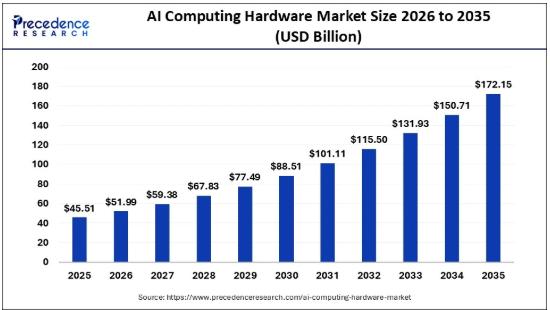
The global AI computing hardware market is poised for significant growth, with a projected increase from USD 45.51 billion in 2025 to USD 172.15 billion by 2035, according to a report by Precedence Research. This meteoric rise is driven by the surging demand for high-performance computing solutions and the proliferation of AI applications across multiple sectors, including healthcare, automotive, and data centers. The report highlights a robust compound annual growth rate (CAGR) of 14.23% from 2026 to 2035, underscoring the transformative potential of AI technologies in shaping modern industries.
As AI systems become more integral to business operations, the hardware requirements are evolving. AI accelerators and Graphics Processing Units (GPUs) are increasingly designed to support complex machine learning models, significantly enhancing computational speed and accuracy. This trend is further complemented by a growing focus on energy-efficient chips, aligning with global sustainability efforts and influencing the design landscape of next-generation AI hardware.
The demand for high-performance computing is particularly pronounced in sectors such as healthcare and finance, where AI processes necessitate sophisticated hardware capable of managing vast datasets and intricate computations. Additionally, advancements in cloud and data center infrastructure are propelling the need for specialized computing units, further driving market growth.
Key trends in the AI computing hardware market include the adoption of specialized chips, including GPUs and Application-Specific Integrated Circuits (ASICs), tailored for AI workloads. The convergence of AI with machine learning and natural language processing is compelling organizations to seek increasingly powerful computing infrastructures. Government investments in AI initiatives are also noteworthy; for instance, South Korea’s Ministry of Science and ICT is actively developing AI computing centers to bolster research and infrastructure.
The North American region dominated the AI computing hardware market in 2025, valued at USD 19.11 billion, and is expected to grow to USD 73.16 billion by 2035 at a CAGR of 14.37%. The United States leads this growth, benefiting from a strong semiconductor ecosystem and substantial investments in cloud infrastructure. Meanwhile, the Asia-Pacific region is projected to exhibit the fastest growth rate, fueled by rapid digitalization and robust investments in AI capabilities. China, in particular, is making significant strides in semiconductor production and AI infrastructure.
From 2026 to 2035, the U.S. is expected to experience a CAGR of 14.44%, maintaining a dominant position in the AI computing hardware landscape. China follows with a CAGR of 14.32%, driven by its focus on AI technologies. India is set to lead with a growth rate of 15.01%, reflecting its swift digital transformation and increasing AI adoption. Germany and the United Kingdom are also expected to experience steady growth, while Brazil is anticipated to achieve a CAGR of 12.60% as its AI hardware sector progresses.
The GPU segment is expected to dominate the market in 2025, thanks to their superior parallel processing capabilities, crucial for AI tasks such as deep learning. ASICs are forecasted to experience the fastest growth through 2035, as they are optimized for specific tasks, delivering enhanced speed and efficiency for AI training. The machine learning application segment led the market in 2025, while natural language processing is anticipated to see rapid growth, driven by demand from chatbots, voice assistants, and AI content generation.
Leading companies in the AI computing hardware sector include NVIDIA, Intel, AMD, and Google, each offering advanced solutions tailored for AI workloads. NVIDIA’s upcoming Vera Rubin platform, which features a suite of specialized chips for AI supercomputing, promises efficiency gains of up to five times over prior generations. Intel’s Core Ultra Series 3 processors are designed for edge applications, while AMD’s MI455 and MI500 GPUs cater to data center AI requirements.
Recent innovations also highlight the competitive landscape, with companies like Huawei launching new products aimed at accelerating AI computing capabilities. Broadcom introduced the Tomahawk Ultra networking processor to enhance data communication in AI data centers, and NVIDIA’s Blackwell Ultra platform aims to improve performance for AI training and inference tasks.
Overall, the AI computing hardware market is on a robust growth trajectory, fueled by technological advancements and an increasing reliance on AI across various industries. As innovative solutions continue to emerge, the demand for specialized computing hardware capable of supporting large-scale data processing and complex machine learning algorithms will only intensify, positioning the market for substantial future advancement.
See also HOPPR™ AI Foundry Launches NVIDIA’s NV-Reason and NV-Generate for Advanced Medical Imaging
 AI System Successfully Manages Clinical Decision-Making, Matching Medical Student Performance
 Nvidia CEO Jensen Huang Projects $1 Trillion in AI Chip Revenue by 2035
 Nvidia Reveals New CPUs for Agentic AI as GPU Demand Shifts Amid Industry Evolution
 DOJ Rules Anthropic Untrustworthy for Military AI Contracts Amid Ethical Dispute