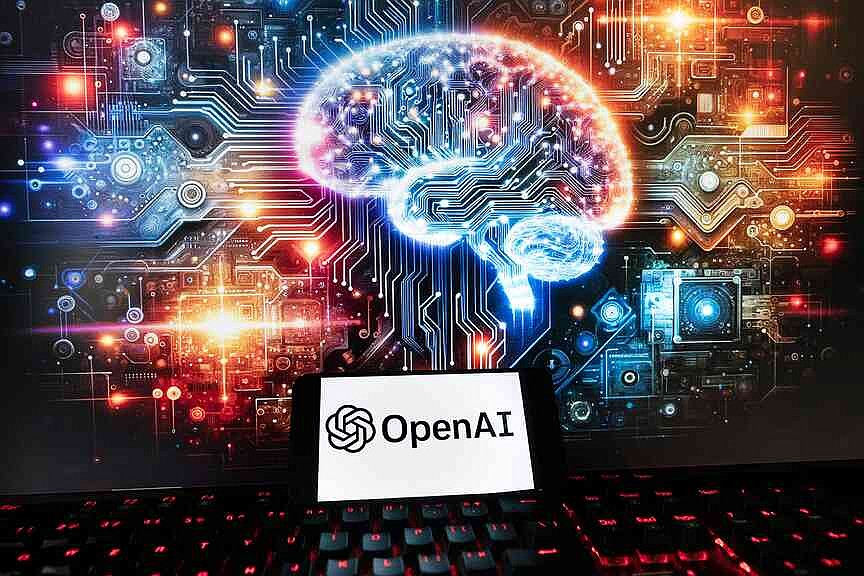
OpenAI is shifting its focus from consumer products to business-oriented solutions as it seeks to enhance profitability and compete with rivals like Anthropic. The company’s chief financial officer, Sarah Friar, recently shared that OpenAI’s ChatGPT, which she uses for personal tasks like cooking, is now also integral to her professional duties, summarizing emails and Slack messages.
OpenAI plans to introduce a new artificial intelligence model aimed at “high-value professional work,” a strategic pivot designed to capture more corporate customers amid rising competition. Friar expressed optimism about the forthcoming model, stating, “You’ll see a new model coming from us in short order. We feel very excited about it.”
Despite boasting over 900 million weekly users of ChatGPT, Friar noted that around 95% do not pay for the service, which puts pressure on OpenAI’s costly computing resources. The company, valued at $852 billion, faces financial headwinds, similar to Anthropic, which is valued at $380 billion, as both entities operate at a loss while striving for profitability.
OpenAI’s recent strategic realignment includes abandoning certain consumer initiatives, such as the AI video generator app Sora, to prioritize improvements in its business offerings. “I think it was a little heartbreaking, but we’re like, ‘OK, it’s not the main event right now,'” Friar remarked. This decision reflects a broader imperative to ensure that the new AI model, codenamed Spud, has adequate computing capacity. It promises “stronger reasoning, better understanding of intent and dependencies, better follow-through, and more reliable output in production.”
As competition heats up, Anthropic has recently launched its Claude Mythos model, which it claims is so advanced that it is limiting access to select customers. In response, OpenAI unveiled a new specialized model, GPT-Rosalind, named after scientist Rosalind Franklin, aimed at enhancing drug discovery and life sciences research.
Since Friar joined OpenAI in 2024, business customers have grown from approximately 20% to 40% of the company’s revenue, with expectations to reach half by year-end. This marks a significant shift from late 2022, when OpenAI was exploring various consumer offerings, including a partnership with Disney for Sora and plans to introduce advertising on ChatGPT.
OpenAI CEO Sam Altman has emphasized the need for a more focused approach, a sentiment echoed by Friar. “Great companies are very good at, in a reasonable period of time, kind of doing that winnowing down and refocusing, and it’s super painful,” she noted. This strategic emphasis is further underscored by the hiring of Slack CEO Denise Dresser as OpenAI’s first chief revenue officer, who is now focusing on establishing partnerships with corporate leaders.
Dresser observed that many companies have moved beyond experimentation with AI and are now looking to implement it for tangible work. “Leaders at companies are recognizing that AI is probably the most consequential shift of their lifetime,” she stated. However, these companies also face competition from Anthropic, which has gained traction among software professionals since its establishment in 2021.
Anthropic’s focus on coding tools has reportedly positioned it favorably, with annualized revenues reaching $30 billion, though OpenAI officials have questioned the accuracy of these figures. Despite differing revenue models and measurements, the competition between the two companies is intensifying, further complicated by the economic landscape and stock market conditions.
As both companies navigate their financial challenges, there are concerns about their long-term viability. Critics have described the situation as a “subprime AI crisis,” highlighting how smaller startups rely heavily on AI tools from these larger firms. Anthropic has introduced rate limits for heavy users, raising access concerns for those who depend on its services.
Overall, the AI industry faces scrutiny regarding the sustainability of its high-cost technology models. Ed Zitron, an AI critic, warned that even public companies can fail, particularly those that depend on massive annual expenditures to maintain operations. “Public companies can and will die, especially ones that are dependent on $100 billion to $200 billion every year or so, just to keep breathing,” he cautioned.
See also Nvidia Targets $20 Trillion Valuation by 2030, Analyst Projects $930 Billion Data-Center Sales
 Meta’s Smart Glasses Surpass Rivals with 2026 Launch and Advanced AI Features
 Nvidia and Nebius Lead Top 5 AI Stocks Under $200 with Exceptional Growth Projections
 Broadcom and AMD Surge in AI Chip Market with Major Meta and Alphabet Partnerships