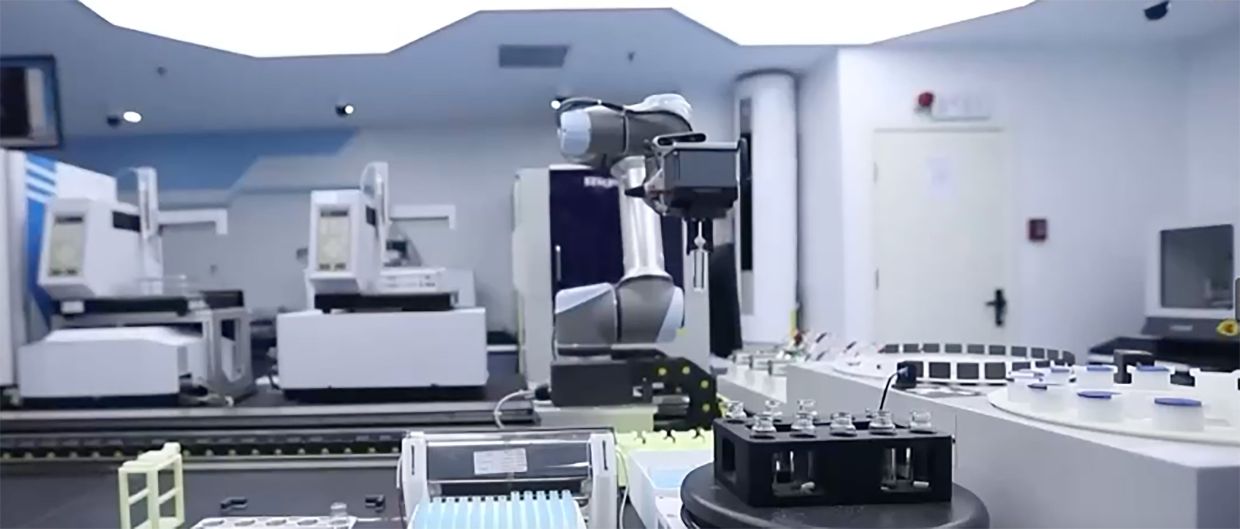
China has launched its largest artificial intelligence computing cluster dedicated to scientific research, which began operations on Tuesday, according to state broadcaster CCTV. This significant development has doubled the number of domestically produced AI accelerator chips to 60,000 units within just two months, marking a notable advancement in the nation’s computing infrastructure.
The AI acceleration cards, developed by Chinese supercomputer firm Sugon, which is linked to the Chinese Academy of Sciences, are now operational in the core node of the national supercomputing network located in Zhengzhou, Henan province. The increase from 30,000 chips, which were in place during trial operations that commenced in early February, positions the Zhengzhou core node as China’s most powerful scientific intelligent computing infrastructure.
CCTV highlighted that this development represents a breakthrough for China’s computing capabilities in AI-driven scientific research, enabling the country to “seize the commanding heights of AI industrial applications.” Researchers in China have faced longstanding challenges in “AI for science” due to limited computing power, software constraints, and reliance on foreign suppliers for critical tools.
The new cluster has been entirely developed domestically, encompassing everything from foundational chips to high-speed interconnects and an advanced software platform. This integrated approach allows for the handling of high-dimensional functions and complex scientific problems, giving researchers the confidence to conduct their most critical tasks in an environment free from external control, as reported by the official Beijing Daily.
In a related development, last week, U.S. lawmakers introduced a bill aimed at further restricting China’s access to advanced chipmaking equipment, seeking alignment with allies such as the Netherlands and Japan to enforce American export curbs within 150 days. This follows a broader initiative launched by the U.S. government in November, known as the Genesis Mission, which aims to build a comprehensive AI platform leveraging federal scientific data to expedite research workflows and scientific breakthroughs.
Adding to its advancements, Sugon recently unveiled its first one-stop development platform called OneScience. This platform hosts numerous scientific models and datasets, eliminating the need for programming skills, thereby democratizing access to advanced research tools. Early results indicate accelerated scientific progress across various disciplines.
In drug development, the national Changping Laboratory has leveraged the cluster to significantly expedite the creation of new drugs, achieving a simulation speed for protein folding that is three to six orders of magnitude faster than previous methods. Tasks that once required years to complete can now be finalized in just days, illustrating the potential of this technology.
Similarly, in materials science, the Chinese Academy of Sciences’ Institute of Computing Technology has successfully reduced the material screening process from years to mere days. The new computing cluster also supports groundbreaking research in fields such as new materials, brain science, and aerospace. It has enabled massive simulations involving 41.47 billion atoms, including the first simulation of the human brain’s 86 billion neurons and extensive turbulence simulations across trillions of grids.
The advancements in China’s AI computing capabilities not only reflect a strategic push in high-performance computing but also highlight the nation’s commitment to fostering innovation and self-sufficiency in critical technologies. As the global landscape for AI continues to evolve, developments like these position China as a formidable player in the race for AI dominance.
See also BMW Group and University of Zagreb Optimize Battery Cell Production with AI, Reducing Costs by 50%
 AI Will Redefine Legal Education, Says University of Sydney’s Law School Leadership
 NPL Integrates NVIDIA Ising AI to Automate Quantum Calibration and Enhance Stability
 Microsoft Executive Predicts AI Will Fuel Software Growth Despite Job Concerns