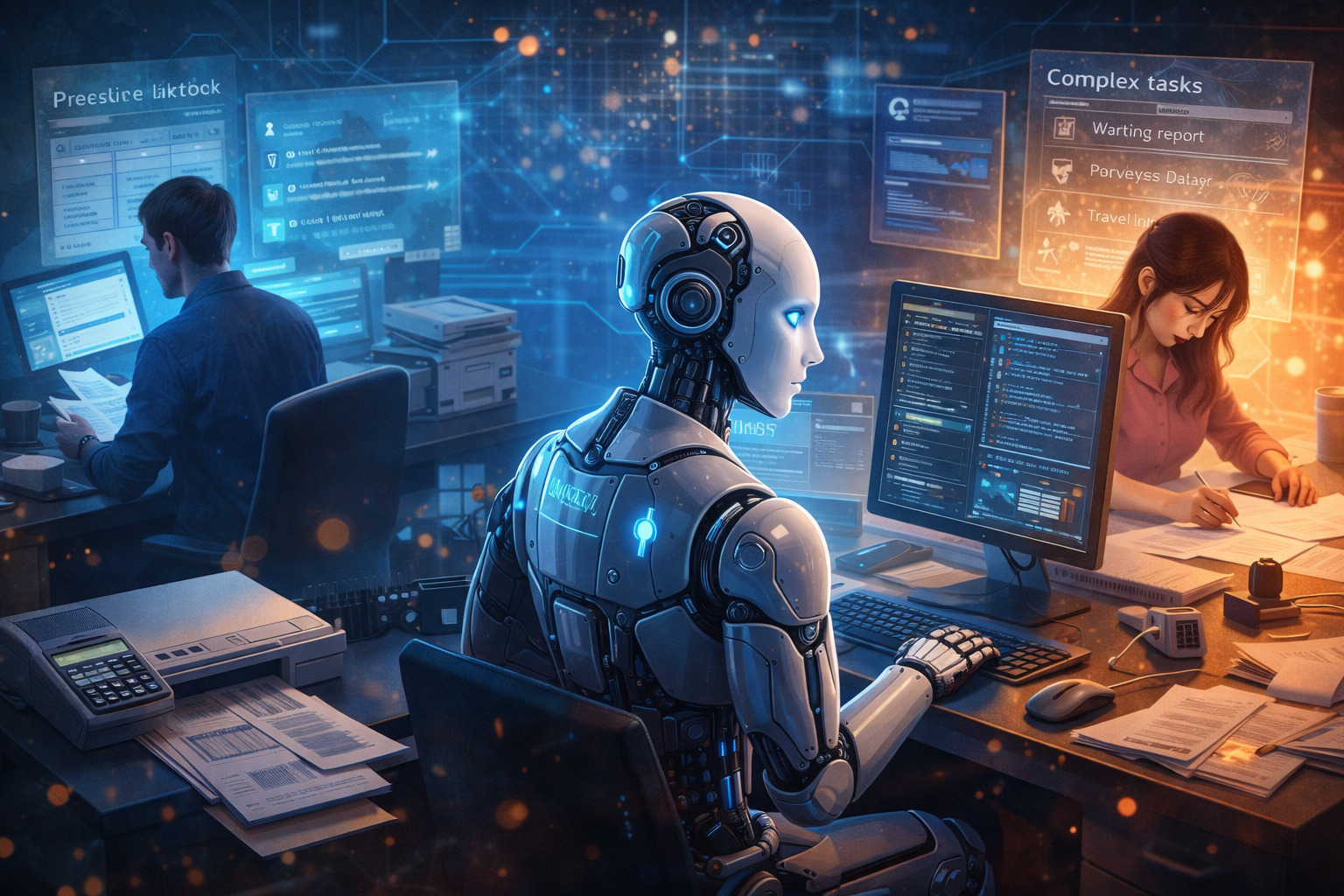
A recent study by Anthropic challenges the widely accepted narrative that artificial intelligence (AI) primarily takes over mundane tasks, allowing humans to focus on more creative and strategic responsibilities. Instead, the research indicates a troubling trend: companies are increasingly outsourcing complex tasks to AI, which may hinder skill development among employees. This analysis, drawn from approximately two million anonymized data points collected in November 2025, reveals that humans are more inclined to delegate cognitively demanding tasks to AI systems while retaining simpler tasks for themselves.
The findings illustrate a notable inefficiency in workplace dynamics. The study shows that AI, specifically its system called Claude, achieves a success rate of about 70 percent for simple tasks, while its success rate declines to 66 percent for more complex activities. Despite this discrepancy, many organizations opt to utilize AI for complex tasks, driven primarily by the perception of time savings. Tasks that typically require around three hours can be reduced to approximately 15 minutes with AI assistance, leading to a preference for speed over precision.
Anthropic’s research raises concerns about what is termed “deskilling,” a phenomenon where professionals gradually lose essential skills as they offload complex tasks to AI. This trend is particularly prevalent in knowledge-intensive sectors, such as technical editing and travel planning, where professionals increasingly rely on AI for analysis and decision-making, leaving them with more straightforward tasks that may not require substantial expertise.
The implications of this shift are profound. Rather than stemming from employee laziness or misuse of AI, the issue is systemic. Companies often prioritize speed, output, and scale, values that align with AI capabilities. Consequently, the erosion of skills may be overlooked in favor of immediate productivity gains, as quarterly performance metrics take precedence over long-term competence development. Moreover, errors produced by AI in complex tasks can be more challenging to identify than those in simpler assignments, compounding the structural risks involved.
The study also highlights a geopolitical dimension to AI adoption. In affluent nations like the United States, Japan, and South Korea, AI is integrated into both professional and daily life. Conversely, in less wealthy countries, AI is primarily utilized for basic tasks or educational purposes. This disparity exacerbates existing inequalities; those who effectively harness AI capabilities enhance their knowledge work, while others remain dependent on limited AI functionality.
Anthropic’s study serves as a sobering reminder that AI’s current impacts are not necessarily dystopian but reflect a stark reality regarding the present use of technology. Rather than merely taking over routine tasks, AI is assuming roles that require critical thinking and judgment, often because it can perform them more quickly than humans. This raises essential questions about the skills that workers may be willing to sacrifice long before AI fully replaces them.
As organizations continue to integrate AI into their workflows, the focus must shift from merely enhancing productivity to understanding the broader implications of deskilling and the potential long-term effects on the workforce. Addressing these challenges will be crucial as society navigates the evolving landscape of work shaped by advanced technologies.
For further exploration of AI and its implications, visit Anthropic, or check other resources like OpenAI and Microsoft.
See also Canada Engages Qatar for Major AI, Energy Funding to Accelerate Infrastructure Projects
 Elon Musk Warns Sam Altman: Trial Will Expose OpenAI’s $134B Controversy
 Global X AIQ ETF Surges 32% in 2025, Outperforming Nasdaq Amid AI Boom
 AI Rally Begins: Expert Predicts Winners Amidst Market Selection, Avoids 2000 Bubble Collapse
 DeepSeek Unveils Engram Technique to Cut AI Memory Costs by 25% and Enhance Reasoning