






















































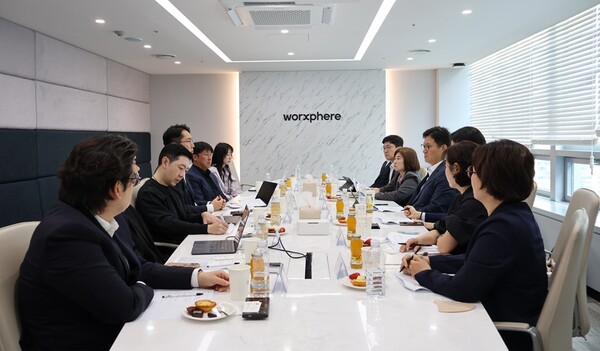
The Ministry of Finance and Economy’s People’s Economy Bureau visited the headquarters of Work Sphere on April 17 to discuss the evolving recruitment market and the policy implications associated with the rise of AI technology. This meeting aimed to assess labor market changes through actual recruitment data and to formulate policy responses as hiring practices across various industries undergo rapid transformation due to AI advancements.
Attendees included People’s Economy Bureau Director Lee Ju-seop and members of the Employment Service Strategy Team. Work Sphere, represented by Chief Executive Yoon Hyun-joon and other executives, engaged in discussions that encompassed broad labor market dynamics, particularly shifts in hiring demand and structures resulting from AI proliferation.
The meeting focused on labor market analysis derived from data provided by the regular employment hiring platform JobKorea. Discussions highlighted changes in the capabilities sought by companies and the ongoing issue of youth hiring mismatches. Work Sphere noted that its internal data indicates significant structural changes within the recruitment market, with an increasing emphasis on hiring individuals with AI and digital competencies. Conversely, some job categories are experiencing reduced hiring, thereby reshaping the landscape.
Work Sphere identified a growing gap between the practical skills required by employers and the level of preparedness among job seekers, describing this mismatch as a critical concern that continues to worsen. Yoon remarked, “As AI spreads and structural changes in the recruitment market accelerate, it is highly meaningful to be able to discuss policy directions together based on on-the-ground data.” He emphasized the company’s commitment to fostering effective, data-driven employment policies through collaboration with governmental agencies, aiming to strengthen its role as a platform bridging companies and job seekers.
The implications of AI in the recruitment sector are profound, with the technology not only influencing hiring practices but also altering the skill sets that are in demand. As organizations adapt to these changes, there is a pressing need for policy frameworks that address the evolving needs of both employers and job seekers. The discussions at Work Sphere’s headquarters underscore the importance of real-time data in informing these policies, as the labor market continues to navigate a landscape increasingly shaped by artificial intelligence.
As the integration of AI technology becomes more prevalent, ongoing dialogue between industry leaders and government officials will be essential in shaping a resilient labor market. The focus will likely remain on bridging the skills gap and ensuring that job seekers are equipped with the necessary competencies to thrive in an AI-driven economy.
See also Google Unveils TPU 8t and TPU 8i AI Chips to Compete with Nvidia and AMD
 AI Will Transform Financial Markets, Says SBI Chairman CS Setty at CCIL Anniversary
 Pakistani Enterprises Set to Transform Finance with AI by 2026, Boosting Accuracy 20%
 SpaceX Announces $60 Billion Option to Acquire AI Startup Cursor to Enhance Coding Tools
 BlackLine Launches Agentic Financial Operations to Enhance Compliance and Control















