






















































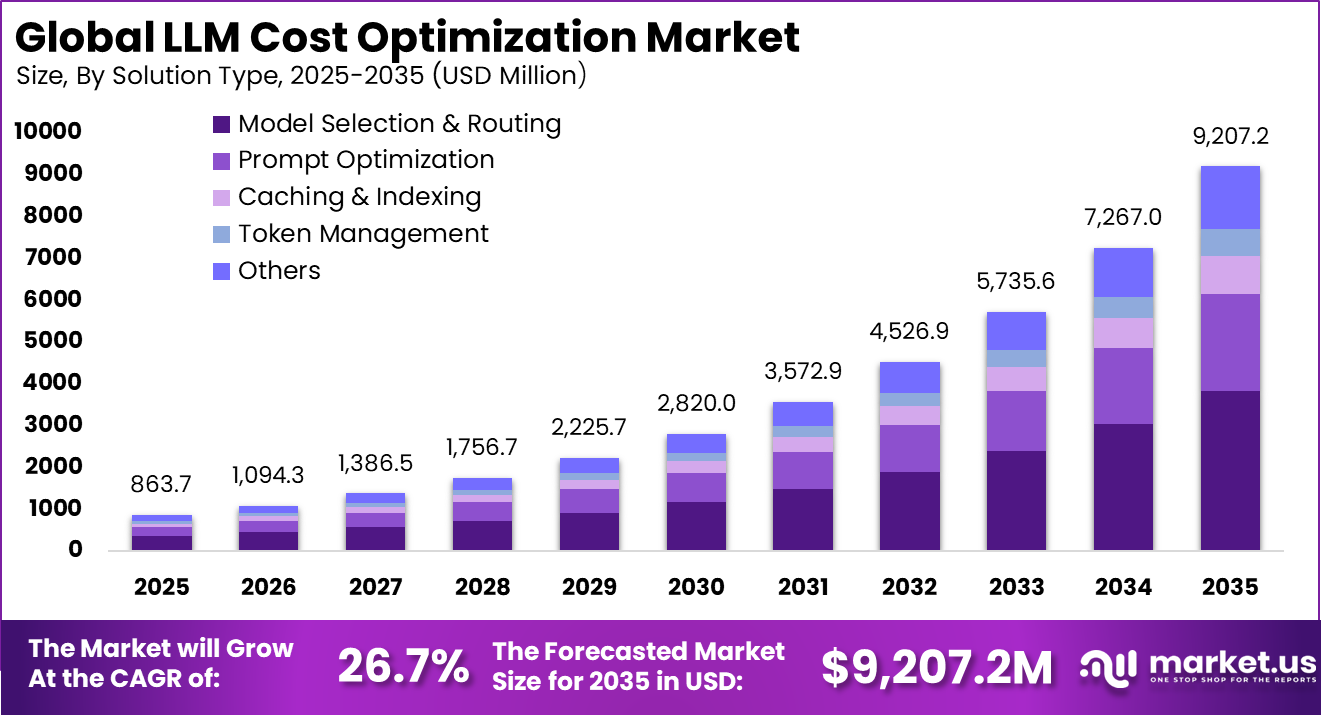
The global market for LLM cost optimization is projected to reach approximately USD 9,207.2 million by 2035, up from USD 863.7 million in 2025, reflecting a compound annual growth rate (CAGR) of 26.7% during this period. North America currently leads the market, accounting for over 44.1% of the share with revenues of USD 380.8 million.
LLM cost optimization encompasses strategies aimed at reducing operational expenses associated with large language models without compromising performance. Key components include efficient compute usage, effective prompt management, and resource planning. The increasing computational demands of advanced AI models, which can account for nearly 70-80% of total costs, underline the necessity for these optimization strategies.
Inefficient token usage exacerbates financial burdens, often contributing to 40-50% of overall expenses. As organizations deploy AI technologies for more complex applications, including data analysis and customer interactions, the need for cost-effective solutions has intensified. Demand for LLM optimization is surging as enterprises face growing query volumes—expected to rise by 60% annually—placing substantial pressure on budgets.
Prominent developments in this sector include AWS’s introduction of the Inference Yield Manager, which reportedly achieved a 40% reduction in total cost of ownership through predictive workload balancing. Financial institutions utilizing Llama models have already seen significant savings, demonstrating the effectiveness of these optimization strategies in maintaining performance while reducing costs.
Market Dynamics
In 2025, the model selection and routing segment led the market with a share of 41.8%, driven by businesses seeking to balance cost and performance by assigning appropriate models for specific tasks. This method allows organizations to optimize resource use, particularly in environments experiencing high volumes of queries.
Similarly, API cost management emerged as a critical area, accounting for 34.6% of the market as firms increasingly rely on API-driven AI services. Effective control over API usage helps mitigate rising costs while ensuring operational efficiency. In February 2026, AWS rolled out features to monitor and reduce API calls, aiding users in managing expenditures during demand spikes.
Enterprises, capturing 58.3% of the market, are primarily driving innovations in LLM cost optimization. As companies embed AI into various functions, managing associated costs has become essential. For example, IBM’s new enterprise dashboards for LLM tracking allow departments to analyze costs effectively, marking a notable shift in how organizations approach AI expense management.
The U.S. LLM cost optimization market, valued at USD 342.8 million in 2025, is projected to grow at a CAGR of 24.9%. Factors contributing to this growth include heightened enterprise AI adoption and rising cloud expenditures, prompting businesses to invest in solutions that enhance model efficiency and mitigate rising costs associated with compute and storage.
North America’s dominance in the global market is attributable to its advanced cloud infrastructure and substantial enterprise investments in AI tools. For instance, Microsoft’s Azure AI Studio introduced auto-scaling inference endpoints that adapt resources based on real-time demand, resulting in cost reductions of up to 40%.
Emerging trends indicate a shift toward integrating generative AI into everyday business processes, reducing operational friction and improving efficiency. Organizations utilizing multi-modal capabilities have recorded up to 50% improvement in engagement, highlighting the dual benefits of enhanced user experiences and cost controls.
However, challenges remain, particularly in balancing cost with quality. Firms are tasked with ensuring that cost-cutting measures do not detract from the performance and reliability of AI outputs. For example, while some companies are experimenting with lower-precision models to reduce compute demands, these adjustments can inadvertently introduce inconsistencies in quality.
Leading technology firms like Microsoft, Google, and AWS are at the forefront of this competitive landscape, focusing on scalable infrastructures and tools designed to minimize the costs associated with LLM deployment. Their advancements in optimized hardware and resource management have demonstrated tangible improvements in cost efficiency, proving critical as enterprises scale their AI operations.
Recent developments, such as Microsoft’s introduction of auto-scaling technologies and Google’s Gemini Cost Optimizer, which lowers inference expenses through intelligent optimization techniques, signal a shift towards more sustainable AI practices. As enterprises increasingly seek affordable AI solutions, the emphasis on effective LLM cost optimization is expected to shape the future of AI deployment across various industries.
See also SwRI Integrates AI Models to Analyze Solar Magnetic Patches, Enhancing Data Retrieval
 Microsoft Launches MAI-Image-2, Securing 3rd Place on AI Image Leaderboard
 OpenAI Reveals Language Models Can Learn Traits Subliminally Through Data Filtering
 rDPO Achieves 82.69% Macro Average Score with Instance-Specific Rubrics in Visual AI Tasks
 OpenAI Set to Launch GPT-6 This Week with Major Upgrades and Faster Development Cycle















